Frame the real decision
Define the represented device state, population, route, duration and evidence question before ordering or reviewing a study.
A chemistry report can exist while the decision chain remains indefensible. This practitioner handbook follows the evidence from the represented finished device and study question through analytical results, exposure assumptions, qualified toxicological reasoning, BEP, BER and lifecycle control.
Individual licence from ₹14,900 / $179Applicable tax extra · 12-month Update Assurance optional · no automatic renewal
First-edition purchase enquiries are open. Review the real preview, then request the exact written offer for your licence and update option. The request creates no order or payment obligation.
Not sure where the evidence chain breaks? Start with the free chemistry-to-TRA handoff diagnostic.
Move from the represented finished device and study question to analytical evidence, exposure reasoning and a bounded specialist conclusion without losing traceability along the way.
Define the represented device state, population, route, duration and evidence question before ordering or reviewing a study.
Judge article representation, sample preparation and extraction logic against the actual decision without turning review into a universal laboratory SOP.
Inspect method coverage, blanks, recovery, identities, quantitation and blind spots while keeping laboratory competence boundaries visible.
Follow units, scaling, release assumptions and transformations into the qualified toxicological handoff instead of treating them as hidden arithmetic.
Carry unknowns, tentative identities, data-poor constituents, conflicting evidence and applicability limits into a bounded conclusion.
Connect the qualified TRA to biological endpoints, BEP, BER, risk management, reviewer response and lifecycle change control.
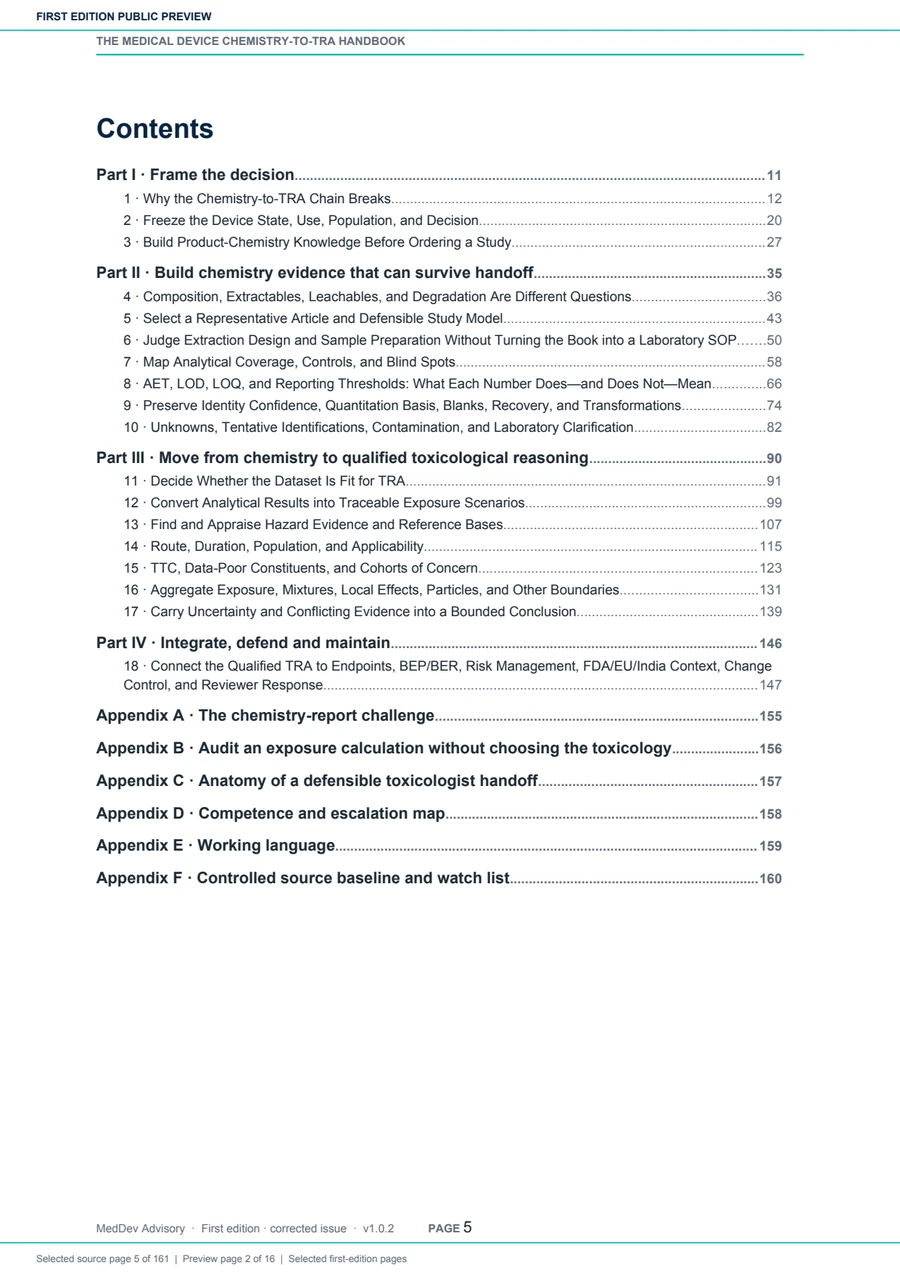
Open each part to inspect every chapter in the complete first edition.
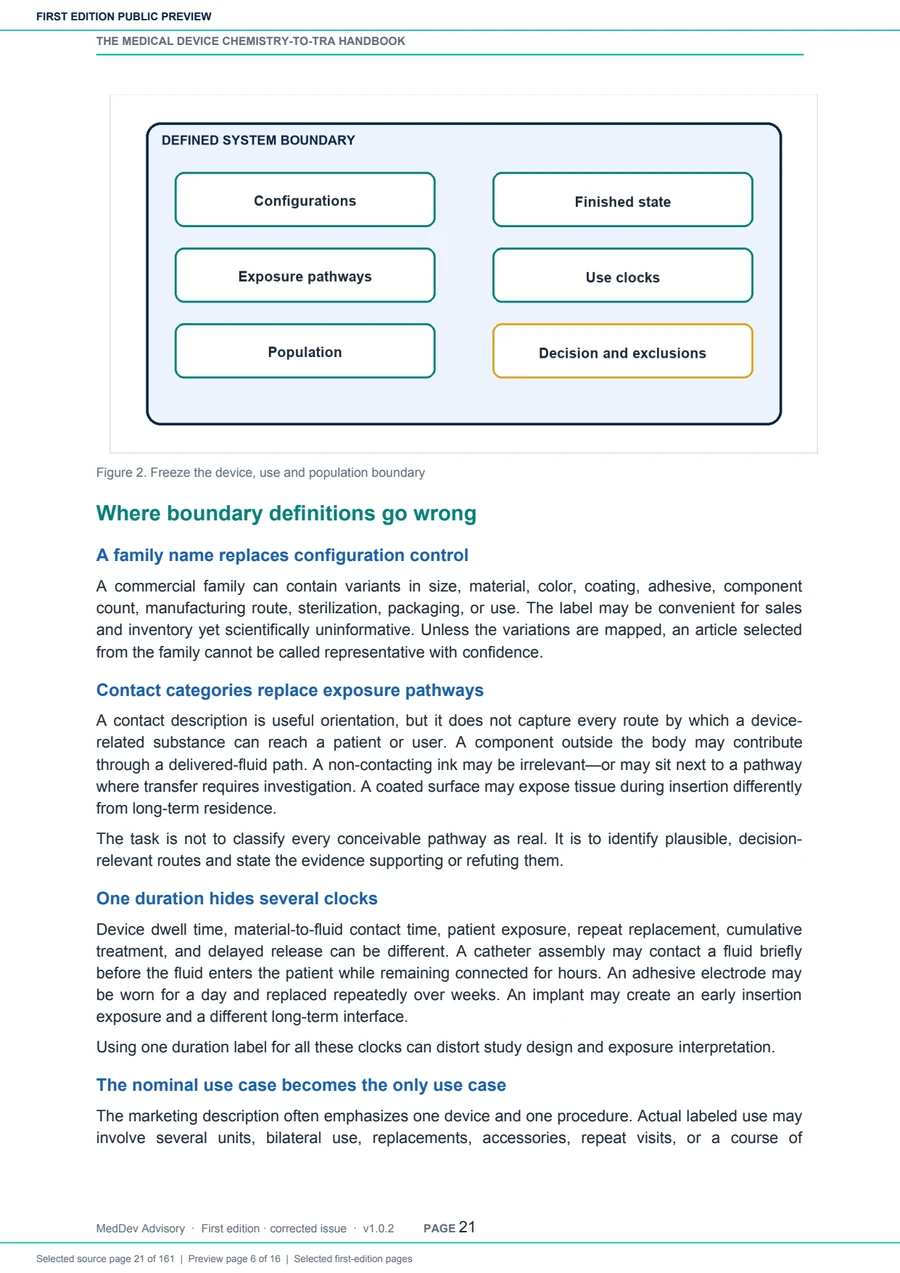
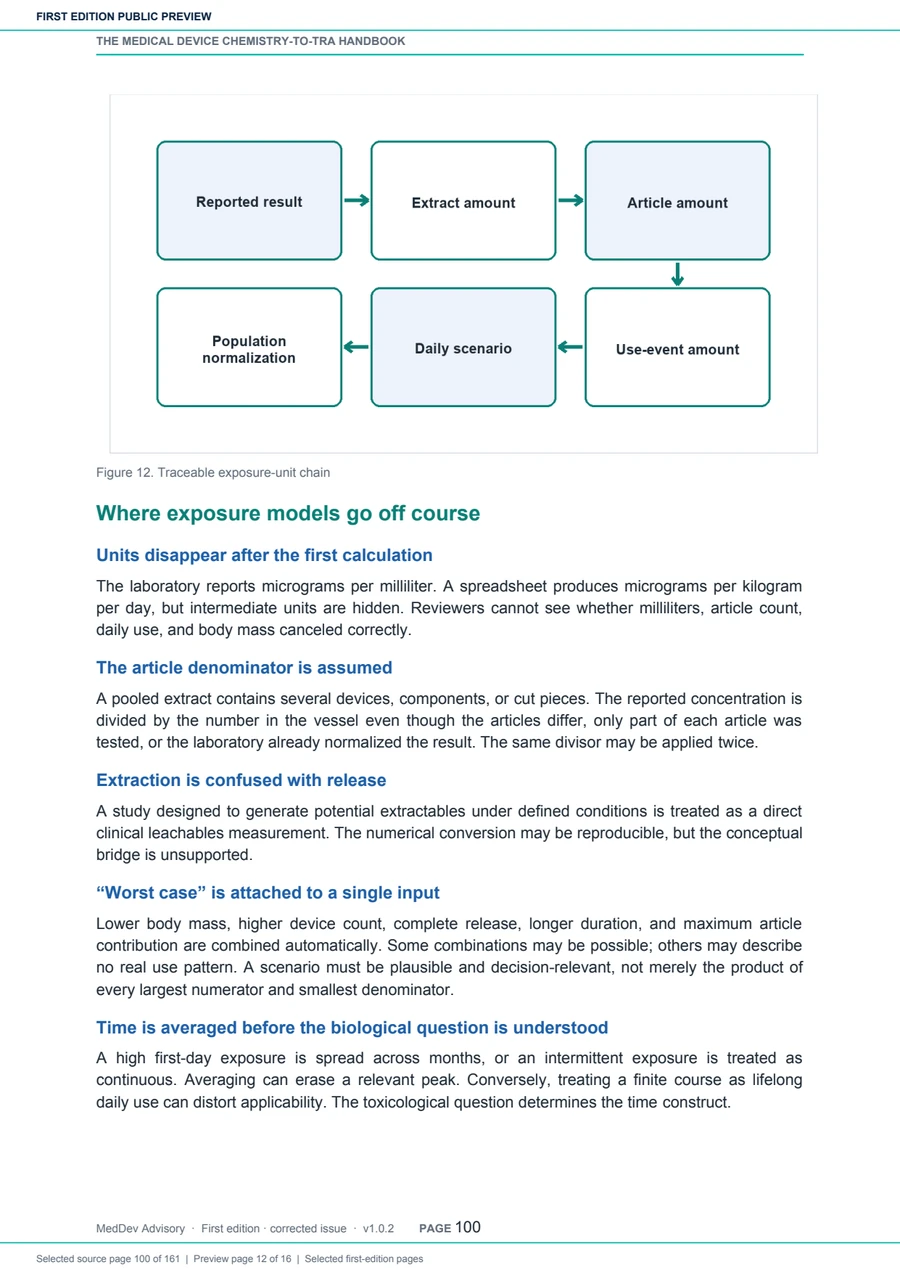
These are direct renders from the complete first edition. The searchable 16-page preview shows selected, non-consecutive pages before you request a written offer.
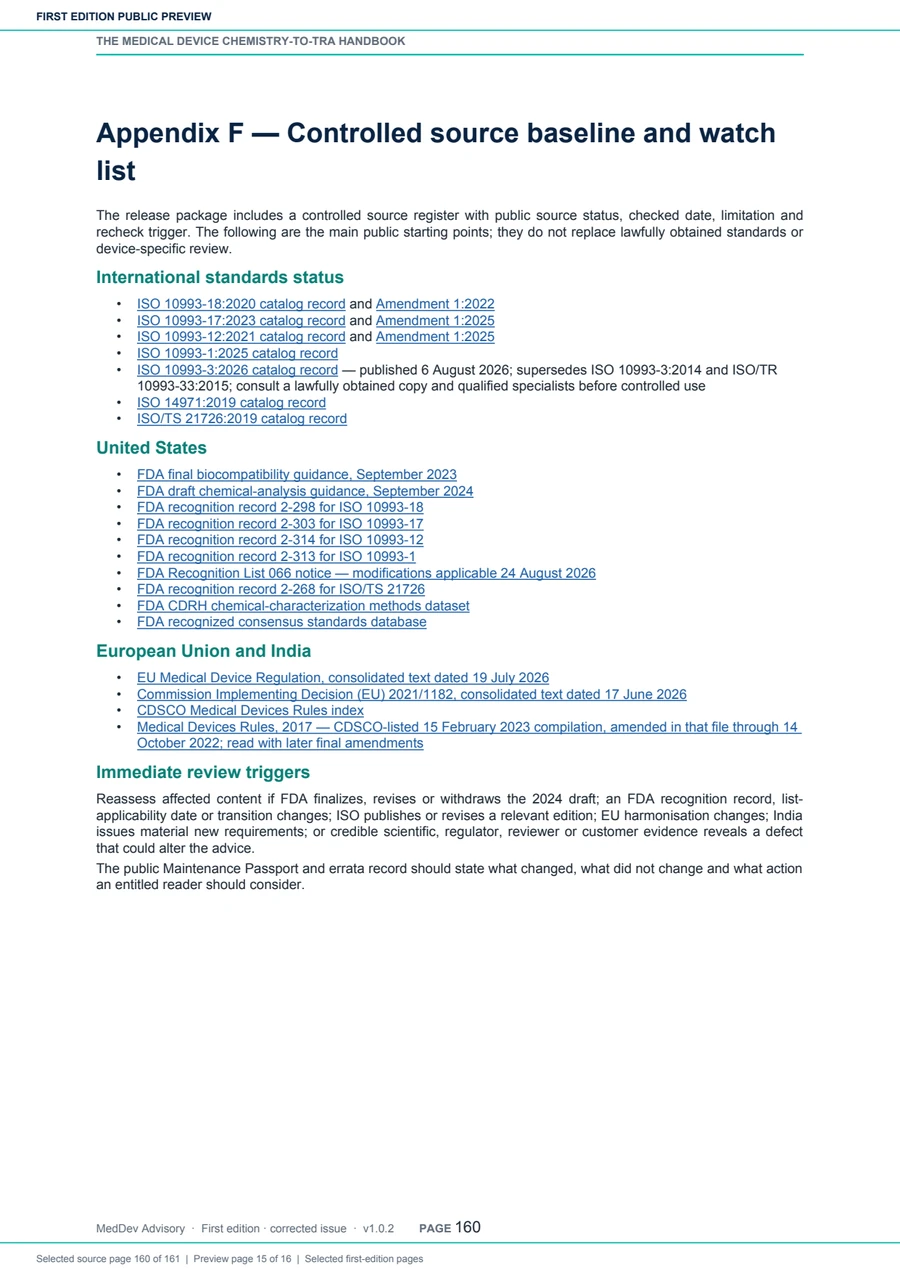
Every licensed package is generated for the named buyer and exact accepted tier. The written offer will identify the exact licensed files, version, price, update option, terms and controlled-delivery method before payment.
The complete 161-page reading edition with structured navigation, descriptive links and searchable text.
Included only with an accepted Organisation or Consultant Practice licence; never included automatically with every tier.
Twenty-five dated source records separating standards, regulator material, recognition status and critical limitations.
Practical orientation, exact edition identity, professional-use boundaries, update treatment and correction policy.
Names the holder, authorised scope, tier, update entitlement, order identity and exact master-file hashes.
Buyer-specific file inventory plus SHA-256 checksums for integrity and document-control verification.
Clear commercial boundary: Online checkout, payment, customer download, and automatic delivery are not currently enabled. Submit a purchase request to receive the exact written offer before you decide whether to pay.
INR applies in India; USD is for eligible international requests and is confirmed in the written offer. Applicable tax is extra. Update Assurance covers eligible updates for 12 months and never renews automatically.
Current edition for your own professional work.
₹19,900 / $239 with 12-month updatesLicensed internal use for the named organisation.
₹59,900 / $749 with 12-month updatesProfessional-use scope for the named consulting practice.
₹99,900 / $1,199 with 12-month updatesEach dossier begins with a plausible but defective handoff and ends with a bounded reasoning path—not a fabricated device-safety conclusion.
A multi-configuration sterile fluid-path assembly with uneven device genealogy, unknown constituents and exposure-scaling questions.
A repeatedly worn adhesive electrode with formulation, repeated-use, local-effect and population questions.
A coated implant that keeps degradation, particles and local-versus-systemic evidence boundaries visible.
A reusable instrument with residue, reprocessing and end-of-life questions that cannot be collapsed into one exposure assumption.
The book is designed to make those boundaries clearer rather than sell one item as a substitute for everything else.
Teaches evidence-chain reasoning, failure analysis, reviewer questions, controlled cases and integration across chemistry, toxicology and biological evaluation.
Provide the requirements and normative text that competent teams must consult in lawfully obtained current copies.
Controls operational records, fields, checks and handoffs for doing and documenting a defined workflow.
Applies qualified judgment to the actual device, study, values, assumptions, evidence gaps and market context.
The controlled source baseline was checked on 1 September 2026. The book preserves each source’s actual role instead of treating every standard, amendment, recognition record or guidance document as interchangeable.
ISO 10993-18:2020, its amendment, and ISO 10993-12:2021 with Amendment 1:2025 are tracked as distinct sources for characterization and sample preparation.
ISO 10993-17:2023 and its published amendment are treated as the specialist toxicological framework, not as an automatic device-safety calculator.
FDA final guidance, consensus-standard recognition and the draft chemical-analysis guidance retain their actual status rather than being presented as one universal rule.

No. It is a medical-device evidence-handoff handbook for competent regulatory, biological-safety and product-safety professionals. It does not qualify a reader to make device-specific toxicological conclusions.
No. Readers need lawful access to applicable standards and current official sources. The handbook teaches original reasoning and review methods without reproducing protected standards.
No. It explains traceability, equation anatomy, exposure assumptions, uncertainty and review questions, but it does not choose real toxicological values or produce an automatic safe-or-unsafe conclusion.
The book teaches judgment, failure analysis and reviewer challenge. The Chemistry / TRA Toolkit controls operational records and handoffs. Neither replaces qualified device-specific review.
First-edition purchase enquiries are open. Submit the offer-request form with your intended licence and update option. MedDev Advisory will send the exact written offer, price, terms and controlled-delivery method for review before any payment.
Every buyer-specific licensed package includes the searchable PDF, controlled source register, release notes, README, licence certificate, package manifest and SHA-256 checksums. The editable DOCX is included only where the accepted Organisation or Consultant Practice licence expressly allows it.
Use the free workflow article to understand the handoff, then move to the handbook for deeper study-design, exposure, toxicology and integration reasoning.
Judge the writing, figures, evidence boundaries and source discipline before deciding whether this handbook belongs in your professional library. Your request creates no order or payment obligation.
 Biological safety
The complete ISO 10993 biological-evaluation reasoning system.
First-edition purchase enquiries open Change control
The cross-functional path from baseline and delta to evidence, authority and monitoring.
First-edition purchase enquiries open