ISO 10993-18 Chemical Characterization Evidence & ISO 10993-17 TRA Handoff Toolkit
Help medical-device teams turn chemical-characterization outputs into a traceable evidence intake, exposure-basis record, and qualified-toxicologist handoff without automating toxicological judgment.
Package at a glance
11 ZIP entries
The current customer archive passed exact-inventory, checksum, and deterministic-rebuild QA.
16 workbook sheets
A fail-closed working system with sample content kept separate.
3-page Quick Start
A concise route through the files, controls, and escalation points.
18 official sources
Source status, limitations, retrieval dates, and recheck triggers.
A traceable working record—not a shortcut to a conclusion
Traceable study-fitness, constituent, exposure-basis, source, and expert-review controls
Characterization Study Fitness
A characterization-study fitness record tied to the final finished device, study purpose, extraction design, analytical coverage, and unresolved limitations.
Traceable Constituent Register
A traceable constituent and unknowns register that preserves identity confidence, reported amount, units, method, source location, concern screening, and action ownership.
Exposure-Basis Package
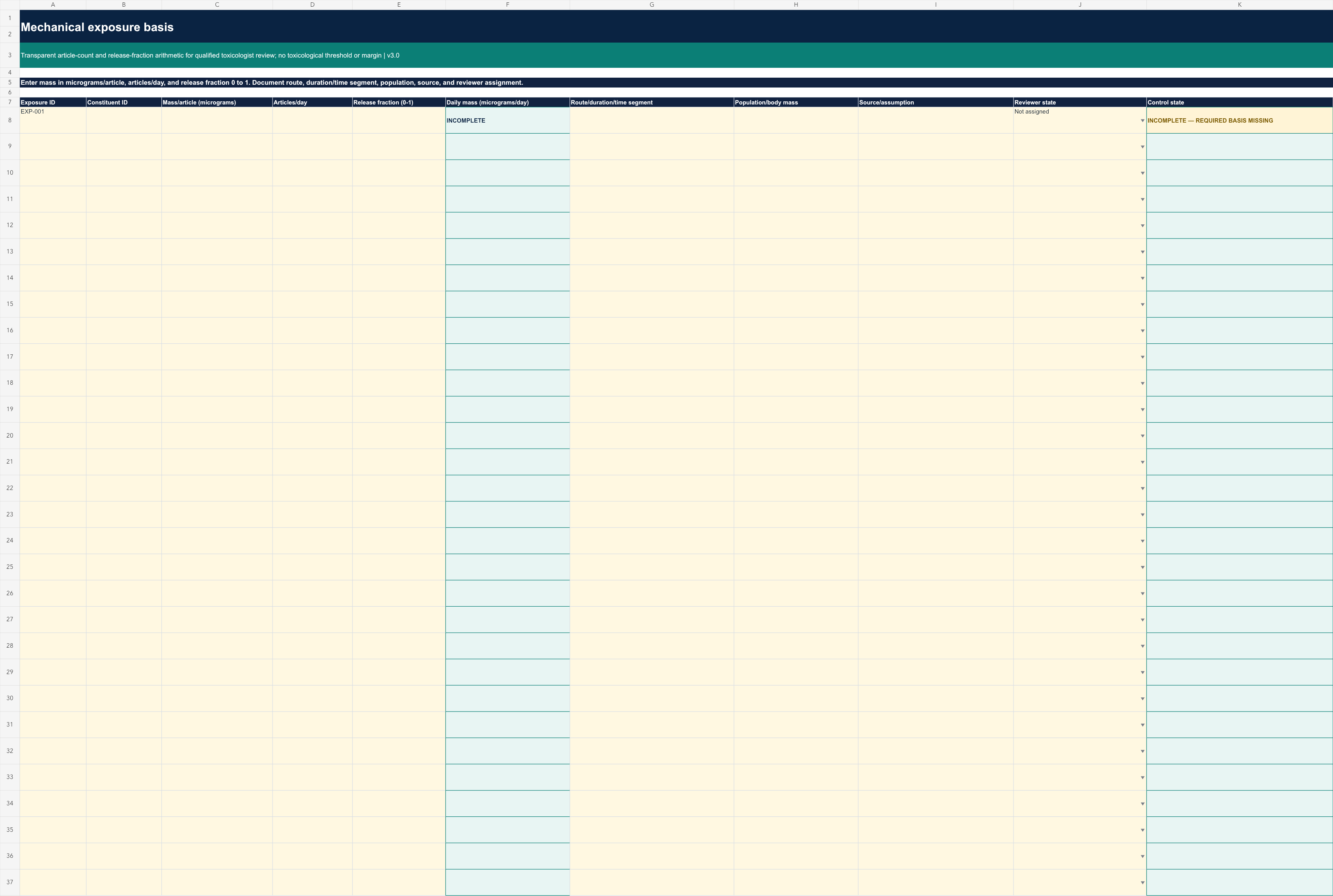
A transparent exposure-basis package showing device count, release fraction, route, duration, population, and source assumptions without choosing a toxicological threshold.
TRA Handoff Record
A structured TRA handoff record that separates chemistry facts, exposure assumptions, toxicology-source decisions, reviewer qualifications, uncertainty, and open questions.
What the current customer edition contains
The verified v3.0 archive contains 11 ZIP entries: 9 buyer payload files plus MANIFEST.csv and SHA-256 checksums. Final document, workbook, visual, and archive-integrity QA are complete.
Quick Start PDF
Use the eight-step route and stop conditions before entering project data.
Complete when: The team understands required inputs, source controls, and escalation.
Implementation Guide PDF
Apply the study-fitness, data-quality, exposure, TRA-handoff, integration, and jurisdiction modules.
Complete when: Each applicable module records its output, evidence, limits, owner, and reviewer.
Editable Working Templates DOCX
Create controlled memos, clarification requests, handoffs, evidence indexes, and approvals.
Complete when: Instruction fields are completed, sources cited, examples removed, and named reviewers approve.
Operational Workbook XLSX
Maintain source, study, constituent, unknown, exposure, assessment, red-flag, action, and example records.
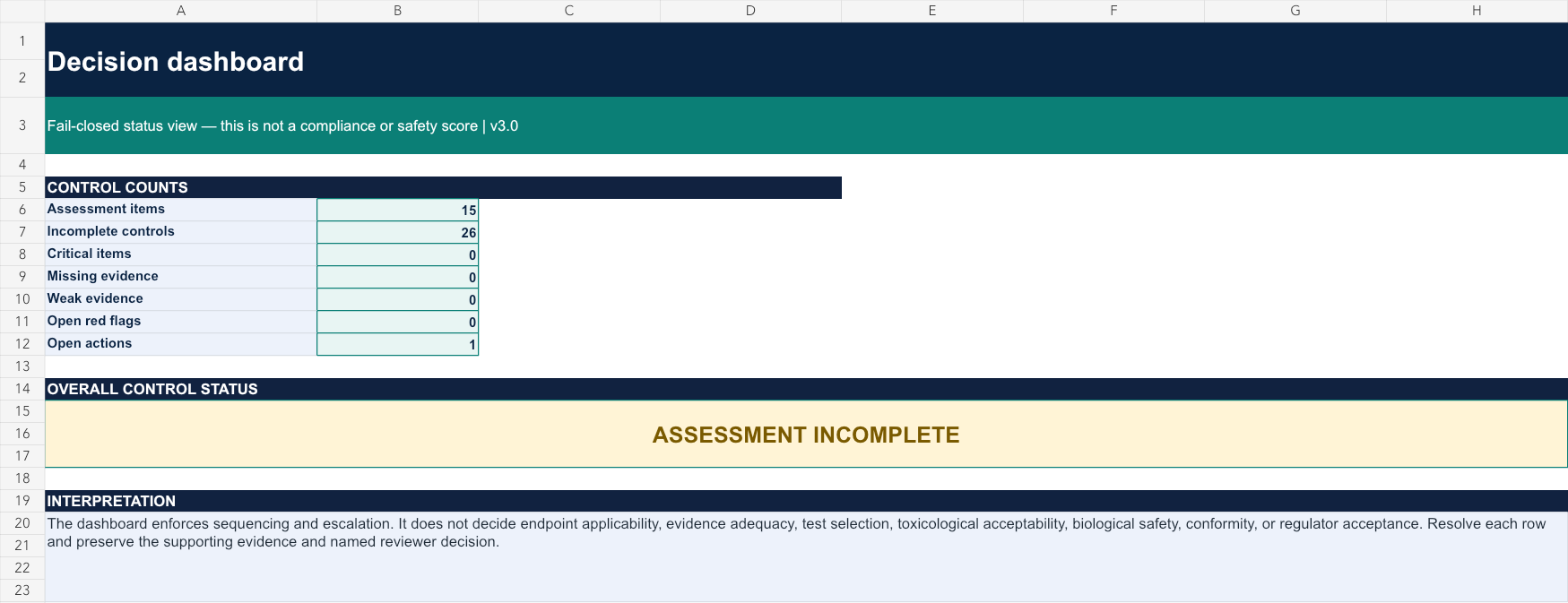
Complete when: The dashboard stays fail-closed until each control has a traceable disposition.
Source Status PDF and CSV
Verify official status, recognition extent, exclusions, draft/final state, transitions, and rechecks.
Complete when: Each decision cites the live source and lawfully consulted edition.
README, Responsible-Use Terms, Manifest, and Checksums
Orient users, control permitted use, confirm package identity, and verify integrity.
Complete when: Inventory and hashes match, and organizational handling rules are applied.
Inspect the actual working system
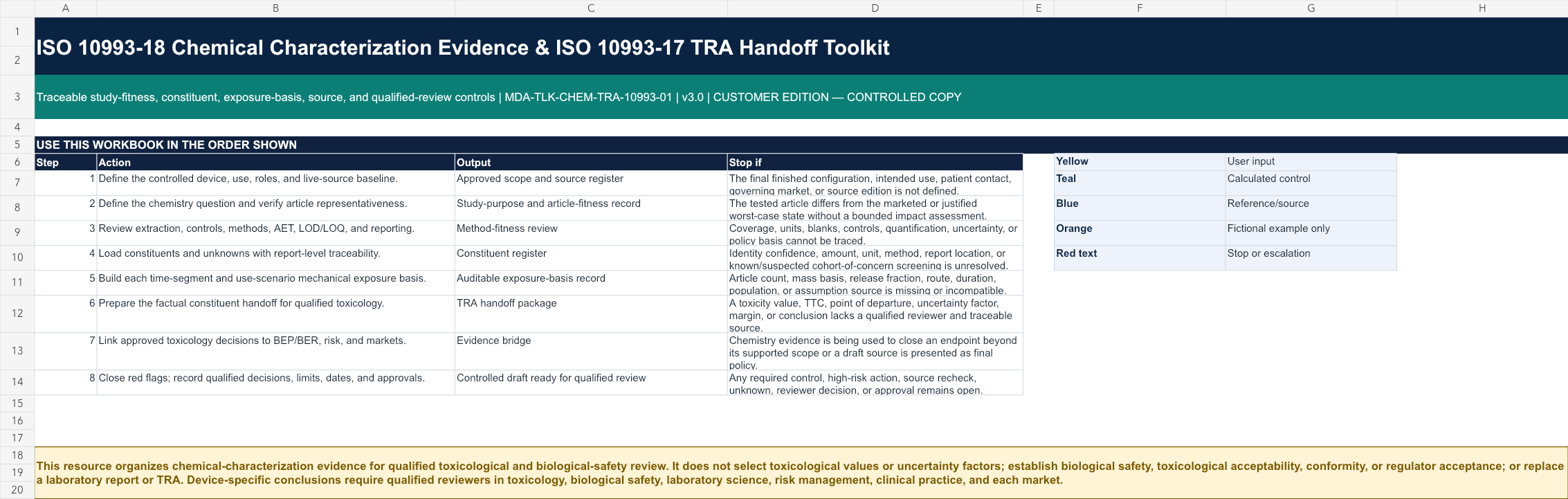
These are direct renders of the current v3.0 workbook prepared as public product views, not marketing mock-ups. Select any image to inspect it at full size.
How the resource is intended to be used
The complete Quick Start and implementation guide are included in the current v3.0 customer edition. This public walkthrough lets a buyer inspect the operating logic and stop conditions before requesting an exact offer.
Approved scope and source register
Define the device, intended use, roles, and current-source baseline.
Stop if: The final finished configuration, intended use, patient contact, governing market, or source edition is not defined.
Study-purpose and article-fitness record
Define the chemistry question and verify article representativeness.
Stop if: The tested article differs from the marketed or justified worst-case state without a bounded impact assessment.
Method-fitness review
Review extraction, controls, methods, AET, LOD/LOQ, and reporting.
Stop if: Coverage, units, blanks, controls, quantification, uncertainty, or policy basis cannot be traced.
Constituent register
Load constituents and unknowns with report-level traceability.
Stop if: Identity confidence, amount, unit, method, report location, or known/suspected cohort-of-concern screening is unresolved.
Auditable exposure-basis record
Build each time-segment and use-scenario mechanical exposure basis.
Stop if: Article count, mass basis, release fraction, route, duration, population, or assumption source is missing or incompatible.
TRA handoff package
Prepare the factual constituent handoff for qualified toxicology.
Stop if: A toxicity value, TTC, point of departure, uncertainty factor, margin, or conclusion lacks a qualified reviewer and traceable source.
Evidence bridge
Link approved toxicology decisions to BEP/BER, risk, and markets.
Stop if: Chemistry evidence is being used to close an endpoint beyond its supported scope or a draft source is presented as final policy.
Draft ready for expert review
Close red flags; record expert decisions, limits, dates, and approvals.
Stop if: Any required control, high-risk action, source recheck, unknown, reviewer decision, or approval remains open.
Current public authorities behind the working controls
Sources were checked 2026-08-02; next planned portfolio recheck is 2026-11-02. Live status must still be verified at each material decision or submission event.
ISO · ISO 10993-18:2020 catalog record
Edition 2 remains published and was reviewed and confirmed in 2025; consult a lawfully obtained copy for requirements.
ISO · ISO 10993-18:2020/Amd 1:2022 catalog record
Published amendment concerning determination of an uncertainty factor; consult the licensed text and current recognition record.
FDA · FDA recognition record 2-298 - ISO 10993-18:2020 including Amendment 1:2022
Partial recognition. FDA excludes specified material in Clauses 5.5 and 7, Tables D.3 and D.5, and identified Annex E statements and examples, including limitations concerning uncertainty-factor treatment.
ISO · ISO 10993-17:2023 catalog record
Edition 2 is published; consult a lawfully obtained copy for toxicological-risk-assessment requirements.
ISO · ISO 10993-17:2023/Amd 1:2025 catalog record
Amendment 1 was published in November 2025. Its ISO publication does not by itself mean FDA has listed the amendment in recognition record 2-303.
FDA · FDA recognition record 2-303 - ISO 10993-17:2023
Partial recognition of the 2023 base edition. The record does not list Amendment 1:2025, excludes specified Annex B and Annex E content, and provides transition from the older recognized edition through 2026-12-20.
What the resource deliberately does not promise
Clear boundaries protect the buyer and make the working records more useful to qualified reviewers.
Clear boundary 1
The toolkit is not a chemical-characterization laboratory protocol and does not replace laboratory method development, validation, raw-data review, or report correction.
Clear boundary 2
The workbook does not choose TTC, TI, TSL, PDE, DNEL, a point of departure, uncertainty factor, or toxicological source and does not calculate an acceptable margin.
Clear boundary 3
Completing the templates does not establish biological safety, endpoint closure, conformity, FDA acceptance, CE marking, CDSCO acceptance, or a no-new-testing conclusion.
Clear boundary 4
The September 2024 FDA chemical-analysis document is draft and Not for Implementation; it is not presented as final FDA policy.
Questions to settle before requesting an offer
Is the current v3.0 edition available?
Yes. The current v3.0 customer edition is released and available by request. Online checkout, payment, customer download, and automatic delivery are not currently enabled. Use Request Exact Offer to receive the controlled offer before deciding whether to pay.
What is included in the current v3.0 edition?
The verified archive contains 11 ZIP entries: 9 buyer payload files plus MANIFEST.csv and SHA-256 checksums. It includes a 3-page Quick Start, 18-page implementation guide, 13-page editable templates, and 16-sheet workbook. Final document, workbook, visual, and archive-integrity QA are complete.
Does the resource provide a completed regulatory or biological conclusion?
No. It provides a traceable working system. Device-specific conclusions, testing decisions, toxicological judgments, and submission decisions require qualified review.
Can I inspect the product before requesting an offer?
Yes. This page shows the complete workflow and real v3.0 product views, while the downloadable 5-page public preview explains the scope, operating logic, included files, and important limits.
How Chemistry Becomes a Qualified TRA and BER Conclusion
Follow the evidence handoff from the represented device and analytical dataset through exposure reasoning, toxicological assessment and biological evaluation.
Review the workflow now. Request the exact current offer.
No order, payment, customer download, or delivery is created through this page. The controlled offer identifies the exact version, licence, price, update option, policies, and delivery method for your review before any payment decision.