Qualify the route
Separate registration, domestic manufacturing, loan-licence, import and investigational contexts before choosing dossier architecture.
For teams preparing biological-safety evidence for a non-IVD device dossier in India: map ISO 10993 evidence into the Device Master File.
Version 1.1.0 is the corrected current edition. It incorporates the final G.S.R. 743(E) and 744(E) amendment stack. Historical version 1.0.1 remains preserved in the correction history and is not supplied as the current edition.
These are direct renders from version 1.1.0. The searchable 16-page preview lets you assess the method and professional boundaries before requesting a written offer.
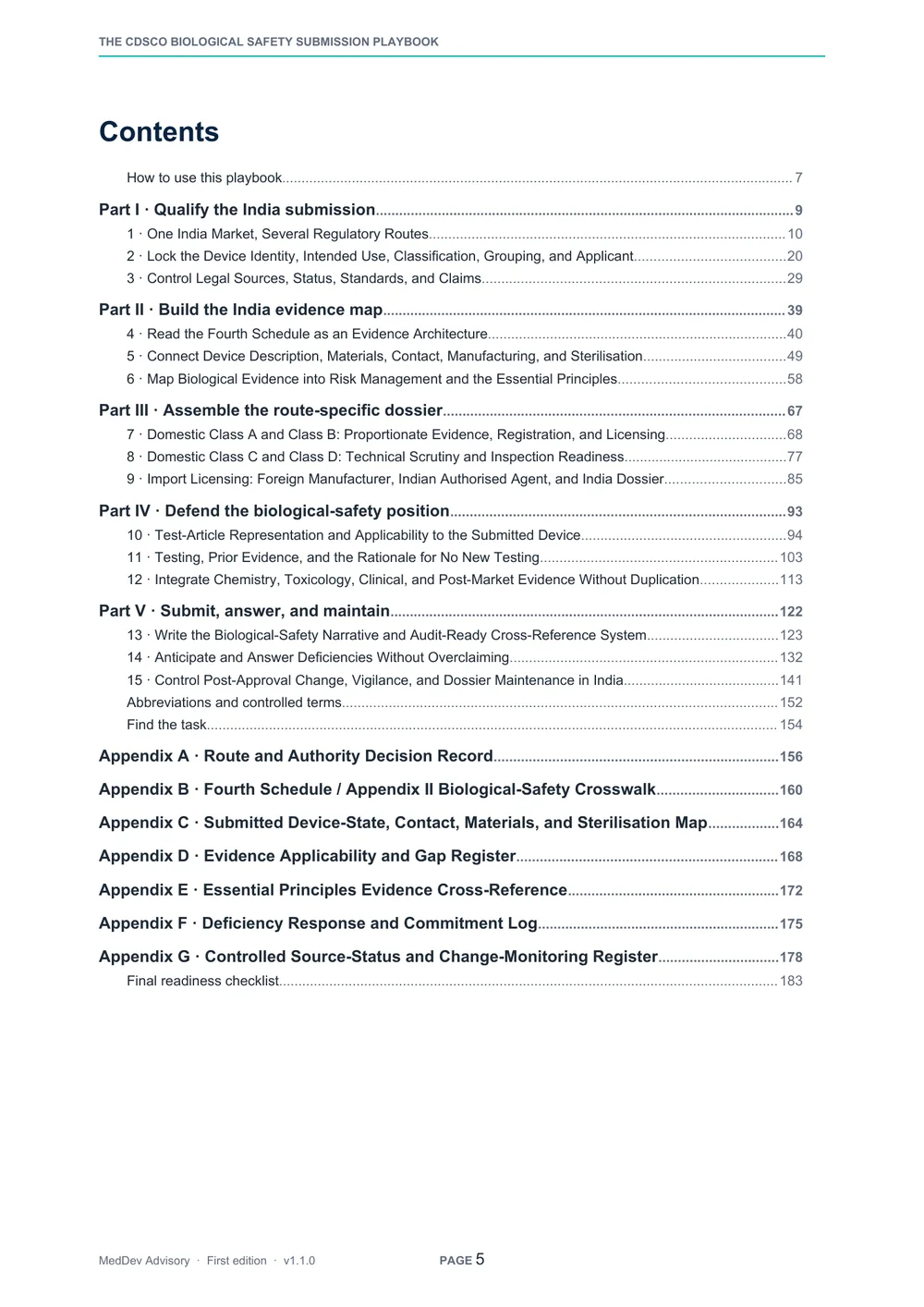
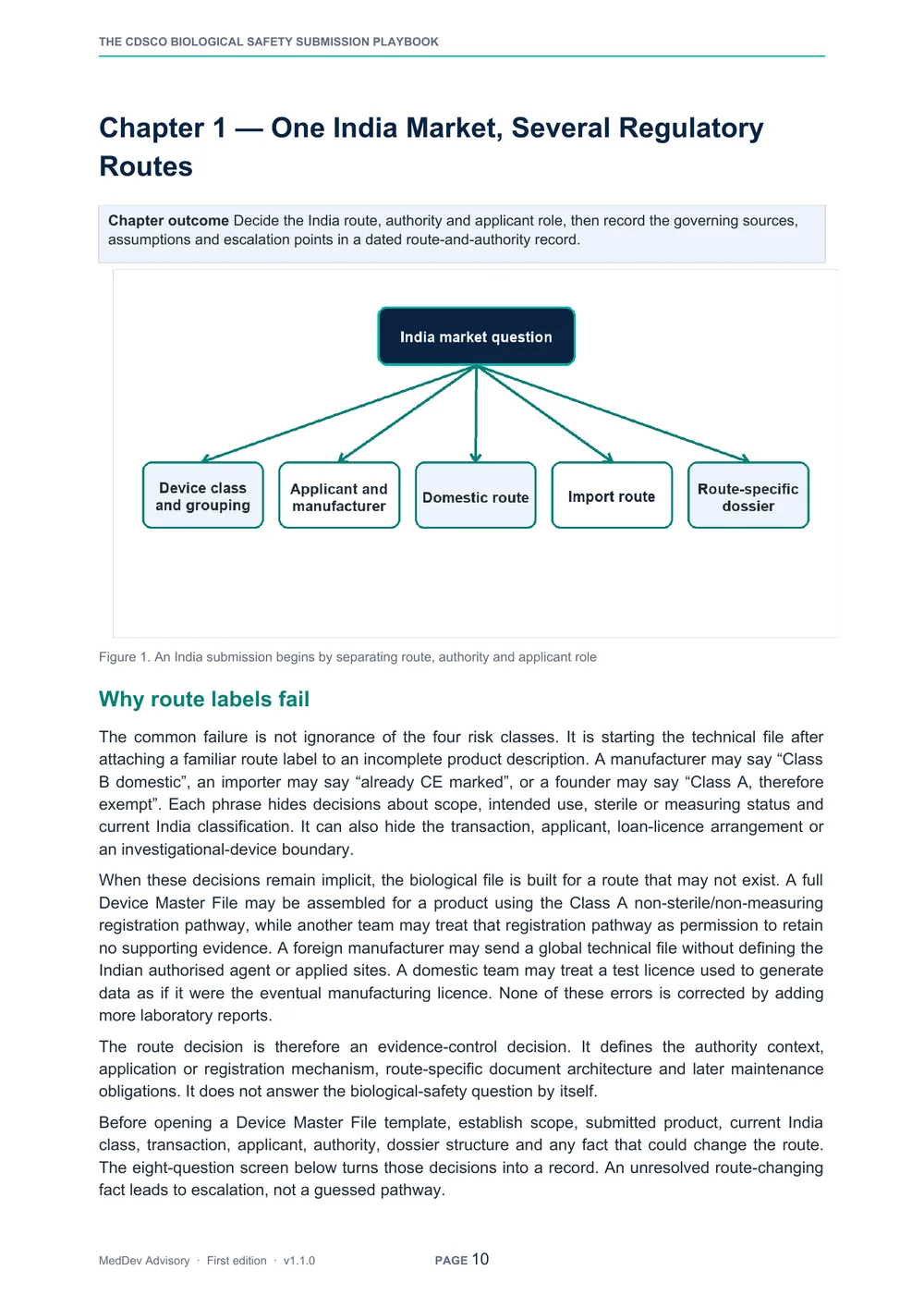
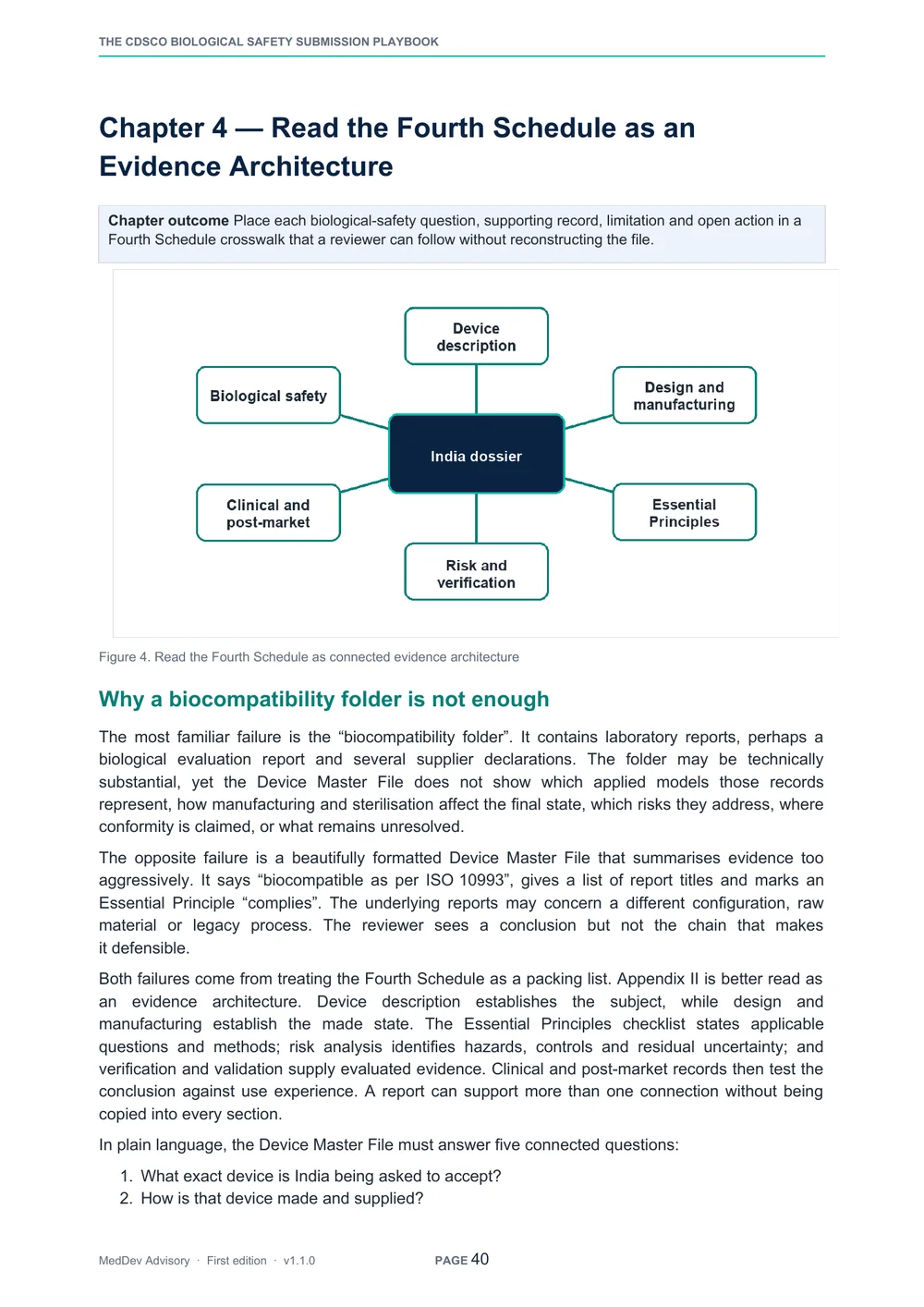
Move from route and device identity to a bounded biological-safety narrative that a reviewer can reconstruct without mistaking a global report for India-specific applicability.
Separate registration, domestic manufacturing, loan-licence, import and investigational contexts before choosing dossier architecture.
Reconcile models, claims, contact, materials, sites, processes, sterilisation, packaging and supplied state to the application.
Keep the Rules, final amendments, guidance, FAQs, portal practice, standards and professional inference in their proper lanes.
Connect Fourth Schedule locations, risk management, Essential Principles and biological evidence without duplicating unsupported claims.
Ask whether each report represents the models, materials, process, site, sterilisation state, use and claim actually submitted.
Write bounded narratives, control deficiency responses and reopen the position when device, evidence or source status changes.
Open each part to inspect every chapter in the complete first edition.
Reference structures show the fields and decision boundaries to transfer into the manufacturer’s controlled QMS records or approved templates.
Record the product, intended use, class, grouping, applicant, transaction, authority, legal anchors, assumptions and escalation points.
Connect biological-safety evidence to Device Master File locations, risk management and Essential Principles evidence.
Reconcile applied configurations, contact components, materials, manufacturing and sterilisation state.
Bound what each report can support, identify mismatches and assign the next competent owner.
Trace the relevant claim to the current approved evidence rather than a generic statement of conformity.
Separate the question, evidence, response, remaining limit, commitment, owner and closure record.
Track source identity, status, checked date, operational role, limitations and events that trigger reassessment.
Challenge whether route, identity, evidence, narrative, owners and unresolved work are visible before submission.
Publisher control: This founder-authored edition is internally source-checked and supported by a controlled source register, correction history and exact master hashes. No regulator approval or external endorsement is implied. It is professional education—not legal or regulatory advice, a device-specific biological evaluation, a submission or a substitute for current official sources, lawfully obtained standards and qualified judgment.
Every buyer-specific licensed package is generated for the named buyer and exact accepted tier. The written offer will identify the exact licensed files, version, price, update option, terms and controlled-delivery method before payment.
The complete 184-page current reading edition identified by product ID, version and SHA-256 hash.
Not included in the Individual tier. It can be included only where the accepted Organisation or Consultant Practice licence expressly allows it.
Fifty-nine dated source records separating legal anchors, final instruments, guidance, administrative material, standards and limitations.
Edition identity, intended use, boundaries, file orientation, correction treatment and update terms.
SHA-256 checksums identify the customer files inside the sealed package for integrity and document-control verification.
The licence certificate and controlled delivery record are issued separately after the applicable offer, identity and payment gates. The internal package manifest is not included in the customer ZIP.
Clear commercial boundary: Online checkout, payment, customer download, and automatic delivery are not currently enabled. Submit a purchase request to receive the exact written offer before you decide whether to pay. Historical version 1.0.1 is preserved in the correction record and is not supplied as the current edition.
INR applies in India; USD is for eligible international requests and is confirmed in the written offer. Applicable tax is extra. Update Assurance covers eligible updates for 12 months and never renews automatically.
Current edition for your own professional work.
₹19,900 / $239 with 12-month updatesLicensed internal use for the named organisation.
₹59,900 / $749 with 12-month updatesProfessional-use scope for the named consulting practice.
₹99,900 / $1,199 with 12-month updatesCurrent official sources: G.S.R. 743(E) and G.S.R. 744(E). The amendments generally commenced on Gazette publication. Only compliance with the new Rule 44 clause (p) is expressly delayed for six months from the notification.
The examples are teaching devices—not client matters, regulator precedents, successful applications or recommendations for a real product.
Shows why a reduced registration route is not an evidence vacuum and why self-certification still needs a controlled basis.
Exposes the distance between material plaques and the finished, processed, sterilised and packaged device.
Tests model, site and evidence reconciliation between the foreign manufacturer and Indian authorised agent.
Keeps degradation, local-tissue, clinical and investigational uncertainties visible instead of collapsing them into “biocompatible”.

No. It is a publisher-authored professional education resource. It is not issued, approved, endorsed or sponsored by CDSCO, the Government of India, BIS, ISO or another authority or standards body.
No. It teaches how to connect device state, biological evidence, risk management, Essential Principles and dossier locations. Qualified professionals remain responsible for device-specific conclusions.
Yes. It separates Class A non-sterile and non-measuring registration, domestic Class A/B and C/D licensing contexts, and import-licensing responsibilities without presenting one universal route.
It is founder-authored, internally source-checked and supported by a controlled source register, correction history, exact master hashes and buyer-specific package records. No external endorsement is implied.
Yes. The 16-page public preview contains real selected pages from the current v1.1.0 edition. A written-offer request creates no order or payment obligation.
Every buyer-specific licensed package includes the searchable PDF, controlled source register, release notes, README and SHA-256 checksums. The licence certificate and controlled delivery record are issued separately after the accepted offer, buyer details and payment have been verified. The editable DOCX is included only where the accepted Organisation or Consultant Practice licence expressly allows it.
Review the India-specific device, route, contact, materials and evidence questions that should be settled before laboratory work begins.
Judge the route logic, dossier architecture, correction controls and professional boundaries before deciding whether this playbook belongs in your professional library. Your request creates no order or payment obligation.
 Biological safety
The broader ISO 10993 biological-evaluation reasoning system.
First-edition purchase enquiries open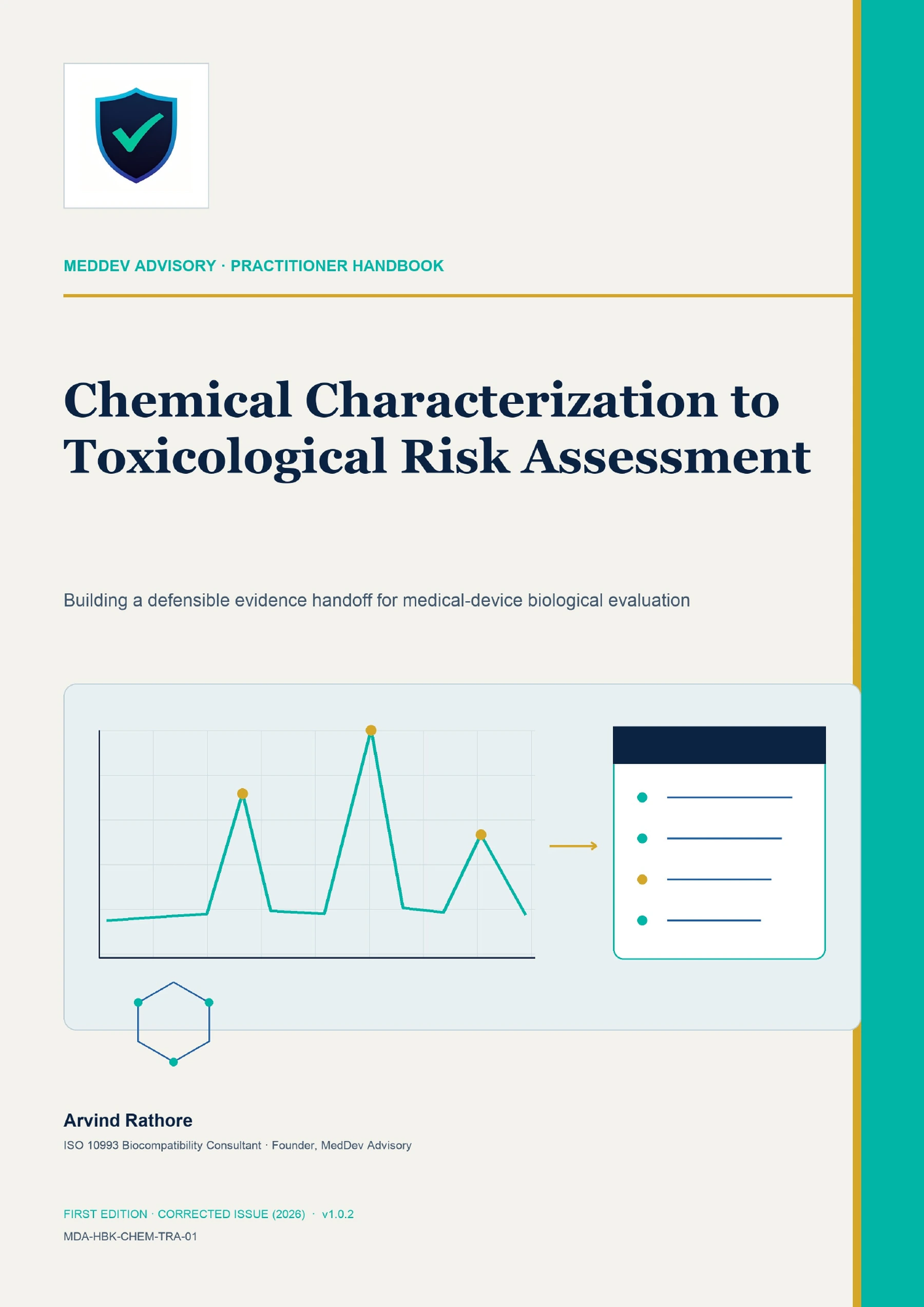 Chemistry and toxicology
The evidence handoff from represented device to qualified toxicological reasoning.
First-edition purchase enquiries open