Define the real evaluation boundary
Connect intended use, device variants, final-finished-device knowledge, manufacturing, preparation, patient contact and exposure before judging evidence.
For professionals planning, reviewing or documenting medical-device biological evaluation. This 201-page handbook helps connect device facts and evidence gaps to a biological evaluation plan and report under ISO 10993-1:2025.
Individual licence from ₹14,900 / $179Applicable tax extra · 12-month Update Assurance optional · no automatic renewal
First-edition purchase enquiries are open. Review the real sample and complete contents before requesting the exact licence offer. No payment is requested on this page; the written offer will identify the edition, licensed files, terms and delivery method.
Need to organize endpoint evidence first? Use the free biological endpoint evidence route planner.

The handbook follows the decisions that make biological evaluation defensible. It is not a test-list summary and does not treat documentation as an afterthought.
Connect intended use, device variants, final-finished-device knowledge, manufacturing, preparation, patient contact and exposure before judging evidence.
Separate provenance, relevance, reliability and applicability so prior tests, literature and comparable-device evidence are used within supportable limits.
Tell a missing record, unknown fact, weak evidence bridge and unresolved biological-safety question apart before commissioning more work.
Use each evidence stream to answer a defined question, preserve competence boundaries and avoid turning tools or calculations into automatic conclusions.
Link the prospective plan, evidence actions, results, deviations, conclusions, limitations, risk controls and lifecycle triggers into one reconstructable argument. Use the free BEP–BER evidence traceability diagnostic to screen an existing plan-to-report chain.
Assess material, supplier, process, sterilization, packaging, use and post-market changes against the approved baseline and cumulative history.
Open each part to inspect every chapter in the full first edition. The sequence moves from device reality to evidence, conclusion, market translation and lifecycle control.
These are direct renders from the handbook. The public PDF contains 16 selected pages with searchable text and preview navigation.


Each buyer-specific licensed package contains up to five buyer files plus a checksum file, depending on licence; the written offer will identify the exact licensed files and package SHA-256 before payment.
A4 reading and citation edition with structured navigation, descriptive links, branded furniture and searchable text.
An editable publication/source file is included only where the specific written licence allows it; it is not included with every tier and may not be redistributed.
A CSV register distinguishing law, regulator material, standards status and scientific evidence, with source dates and monitoring notes.
Concise orientation on stable reading copies, editable use, version identification, source currency and professional-use boundaries.
First-edition scope, source-position highlights and the boundary between corrections, source-status changes and successor editions.
A file-integrity manifest so the licensed package can be verified and controlled inside the buyer’s document system.
Clear commercial boundary: Online checkout, payment, customer download, and automatic delivery are not currently enabled. The written offer will identify the exact version, licence, price, update option, policies and controlled delivery method before you decide whether to pay.
INR applies in India; USD is for eligible international requests and is confirmed in the written offer. Applicable tax is extra. Update Assurance covers eligible updates for 12 months and never renews automatically.
Current edition for your own professional work.
₹19,900 / $239 with 12-month updatesLicensed internal use for the named organisation.
₹59,900 / $749 with 12-month updatesProfessional-use scope for the named consulting practice.
₹99,900 / $1,199 with 12-month updatesTeaches the connected reasoning system, recurring failure modes, competence boundaries, reviewer questions and lifecycle logic across the biological-evaluation file.
Provide the requirements and normative text you must consult in a lawfully obtained current copy. The handbook does not reproduce or replace them.
Structure a defined workflow such as a BEP, BER evidence review, chemistry-to-TRA handoff, material-change assessment or regulator response.
Applies qualified judgment to a particular device, evidence set, market and decision. Scope, roles, inputs and conclusions are separately agreed.

The handbook distinguishes ISO publication from market adoption, recognition and harmonisation. It does not imply that a new edition automatically invalidates every existing evaluation.
ISO 10993-1:2025 was published as the sixth edition in November 2025. Use an authorized copy for the actual requirements and verify amendments or successor status.
FDA recognition record 2-313 was entered on 25 May 2026 and includes specific exclusions, implementation cautions and a transition for the prior recognized edition through 1 July 2029.
EN ISO 10993-1:2025 was listed as harmonised under the EU MDR in June 2026. Harmonisation supports a presumption of conformity only within the stated scope and conditions.
It is written for medical-device regulatory, quality, biological-safety, R&D, laboratory-interface and evidence professionals who need a practical framework for planning, evaluating, documenting or reviewing biological-safety work.
Yes. Version 1.0.3 uses a source-status baseline checked through 1 September 2026 and explains the 2025 edition in context, including FDA partial recognition and transition considerations and EU harmonisation. Live sources must still be rechecked for each controlled decision.
No. It does not reproduce or replace authorized standards, applicable law, a device-specific Biological Evaluation Plan or Report, qualified specialist judgment, the manufacturer’s quality system, or organizational approval.
The written offer will identify the exact version, licensed files, licence scope, price, update option, policies and controlled delivery method before any payment decision.
Yes. The 16-page public preview contains real selected pages from the handbook, including the complete contents, reading guidance, a representative chapter excerpt, decision figures, reviewer questions and the author page.
No blanket lifetime-update promise is made. The exact correction and update entitlement will be stated in the written offer. Critical corrections to MedDev Advisory’s own content should not be hidden as paid routine updates.
Neither. It is a professional reference and reasoning guide. For task-specific working systems, browse the toolkit library. For device-specific analysis or documentation, review the consulting services.
The free strategy guide is a concise web overview. The handbook is the complete 201-page, 19-chapter practitioner reference with a longitudinal case, original decision figures, edge cases, reviewer questions and six appendices.
Read the concise strategy guide first, then use the handbook when you need the complete reasoning system, cases, figures and lifecycle framework.
The public preview shows the writing, contents and decision approach. The offer request creates no order or payment and lets you review the exact licensed files, terms, update option and delivery method first.
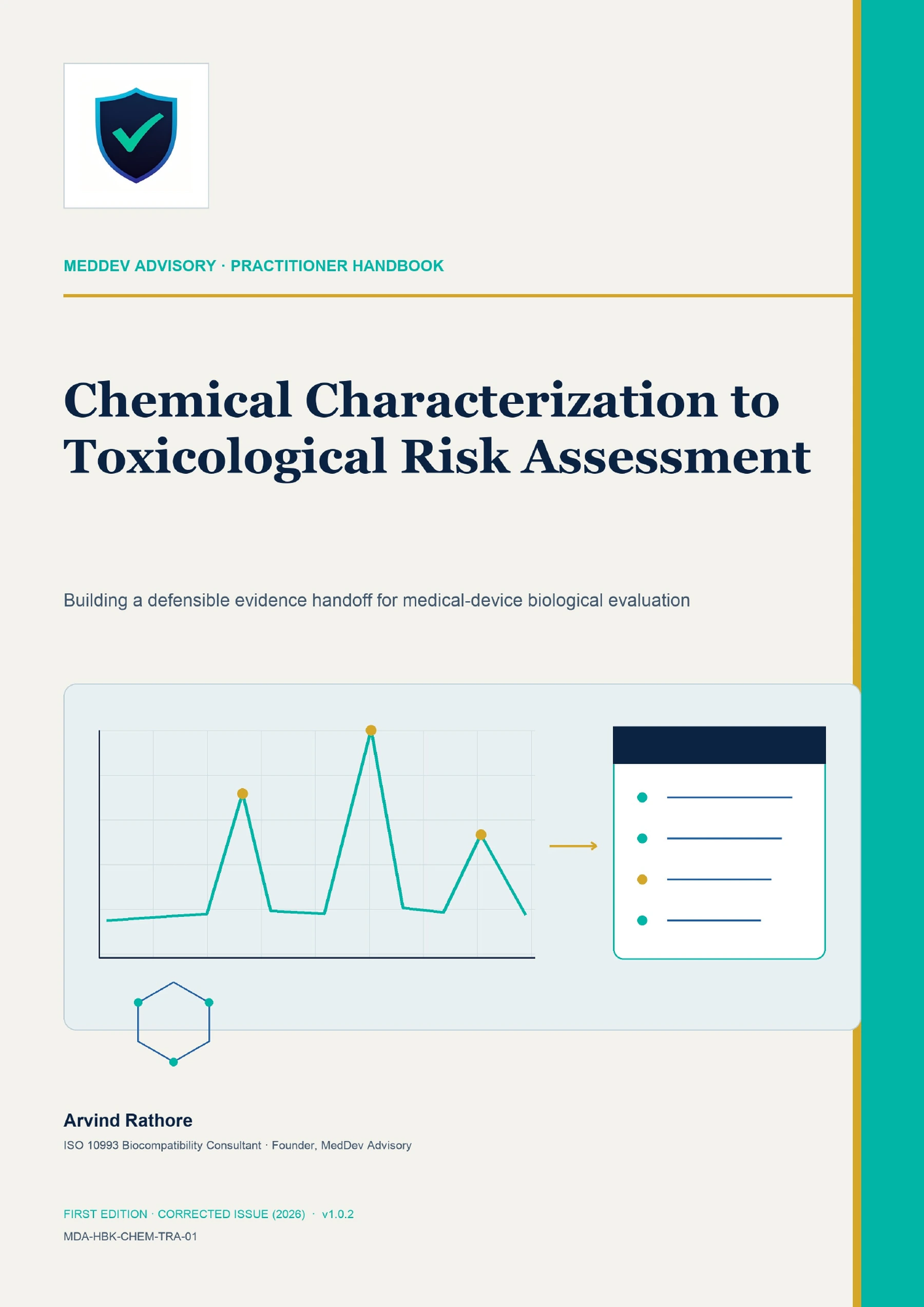 Chemistry and toxicology
The evidence handoff from represented device to qualified toxicological reasoning.
First edition available by written offer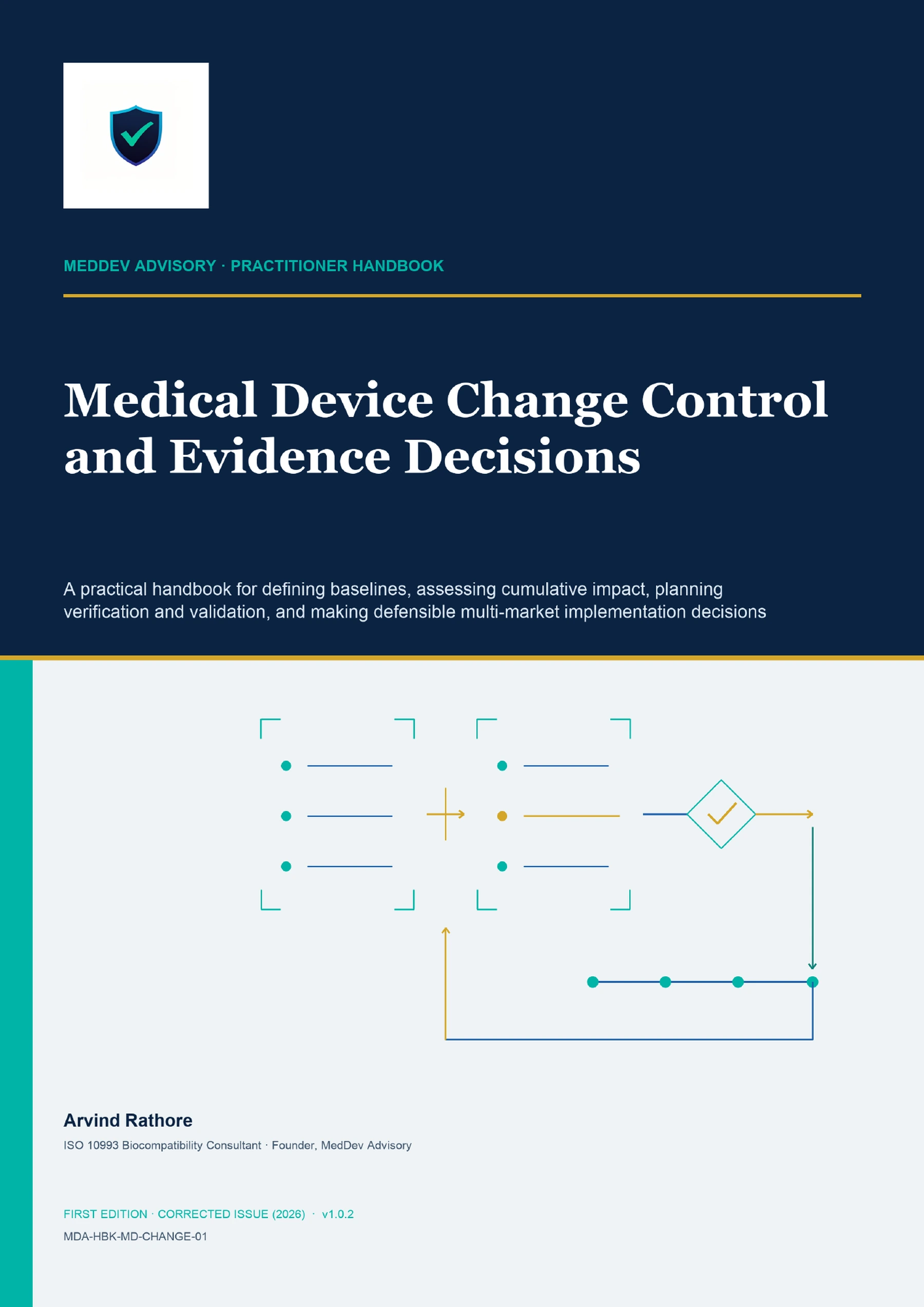 Change control
The cross-functional path from baseline and delta to evidence, authority and monitoring.
First edition available by written offer