Wearable Electrode Biocompatibility & Skin-Contact Evidence Pack
Help medical-device teams build a defensible, component-level biological-evaluation record for wearable electrodes and skin-contact sensor systems across adhesives, conductive media, films, inks, housings, liners, residues, repeated application, sweat, motion, and occlusion.
Package at a glance
11 ZIP entries
The current customer archive passed exact-inventory, checksum, and deterministic-rebuild QA.
18 workbook sheets
A fail-closed working system with sample content kept separate.
3-page Quick Start
A concise route through the files, controls, and escalation points.
17 official sources
Source status, limitations, retrieval dates, and recheck triggers.
A traceable working record—not a shortcut to a conclusion
Component-level contact mapping, cumulative wear control, Attachment G screening, and skin-interface evidence traceability
Controlled Wear Profile
A controlled device and use profile covering intended site, skin condition, wear interval, repeated or adjacent applications, reuse, replacement, target population, and foreseeable exposure.
Component Contact-Zone Map
A component-level contact-zone map for electrodes, conductive gels or hydrogels, adhesives, films, inks, housings, cables, liners, residues, edges, and plausible transfer or migration paths.
Attachment G Decision Record
A final-finished configuration baseline linking formulations, suppliers, manufacturing aids, processing, cleaning, packaging, storage, conditioning, and sterilization where applicable.
Traceable Endpoint Evidence
A cumulative-contact calculation that preserves the actual labelled regimen instead of treating each patch or electrode application as an isolated event.
What the current customer edition contains
The verified v3.0 archive contains 9 buyer payload files plus MANIFEST.csv and SHA-256 checksums. Final document, workbook, visual, and archive-integrity QA are complete.
Quick Start PDF
Set the device, cumulative wear, component-contact, and immediate stop-condition baseline.
Complete when: The team knows what touches whom, where, for how long in total, in what finished state, and which facts remain unresolved.
Implementation Guide PDF
Apply a disciplined wearable-electrode biological-evaluation and evidence-control method.
Complete when: Component mapping, Attachment G boundaries, endpoints, real-use challenges, evidence limitations, and reviewer roles can be explained clearly.
Editable Working Templates DOCX
Draft device, wear, component, eligibility, evidence, endpoint, challenge, change, and approval records.
Complete when: Every blank and fictional field is replaced with controlled device-specific information.
Operational Workbook XLSX
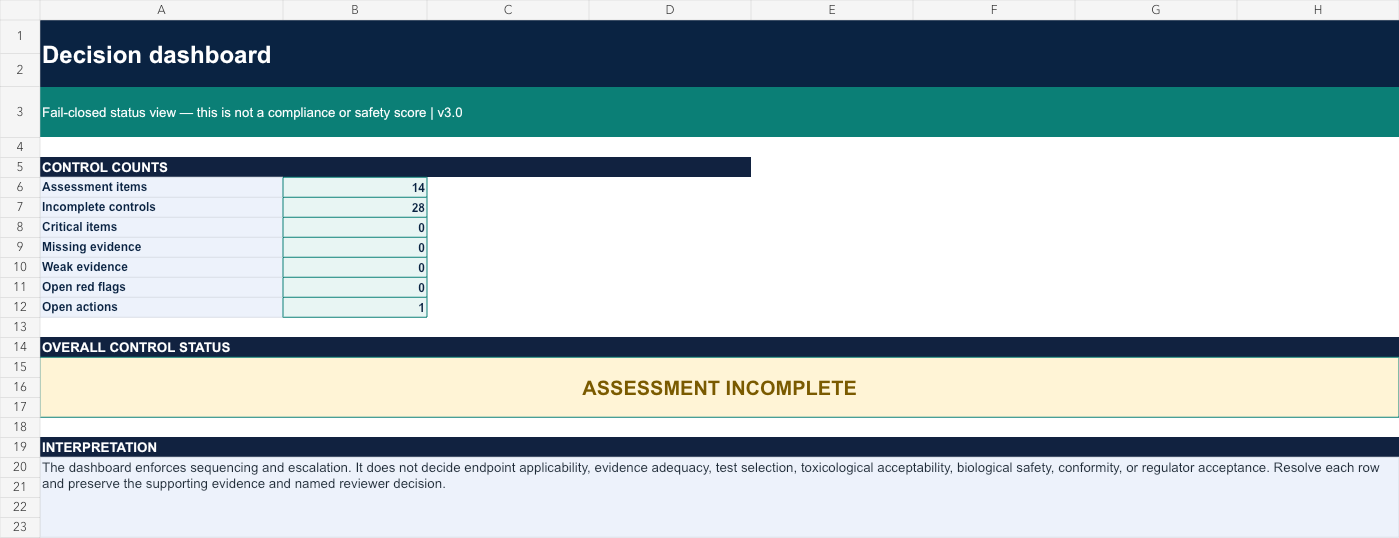
Control the full assessment, formulas, red flags, actions, evidence, and qualified decisions.
Complete when: Every seeded control has complete companion evidence and no unresolved stop condition is hidden.
Source Status and Release Notes PDF
Verify current FDA, ISO, and EU source status, limitations, and recheck triggers.
Complete when: The source register matches the exact public authorities and standards editions used by the team.
README, responsible-use terms, manifest, and checksums
Orient the recipient, preserve package integrity, and control authorized use.
Complete when: Product identity, version, inventory, hashes, support route, and use boundary agree.
Inspect the actual working system
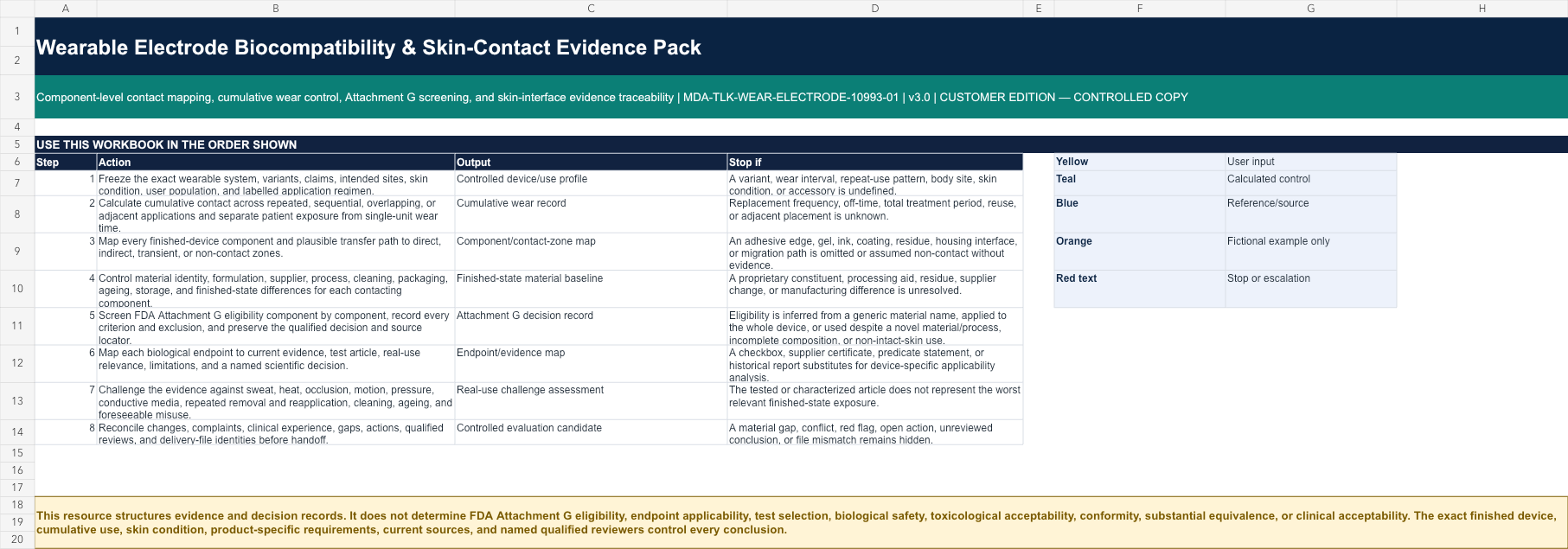
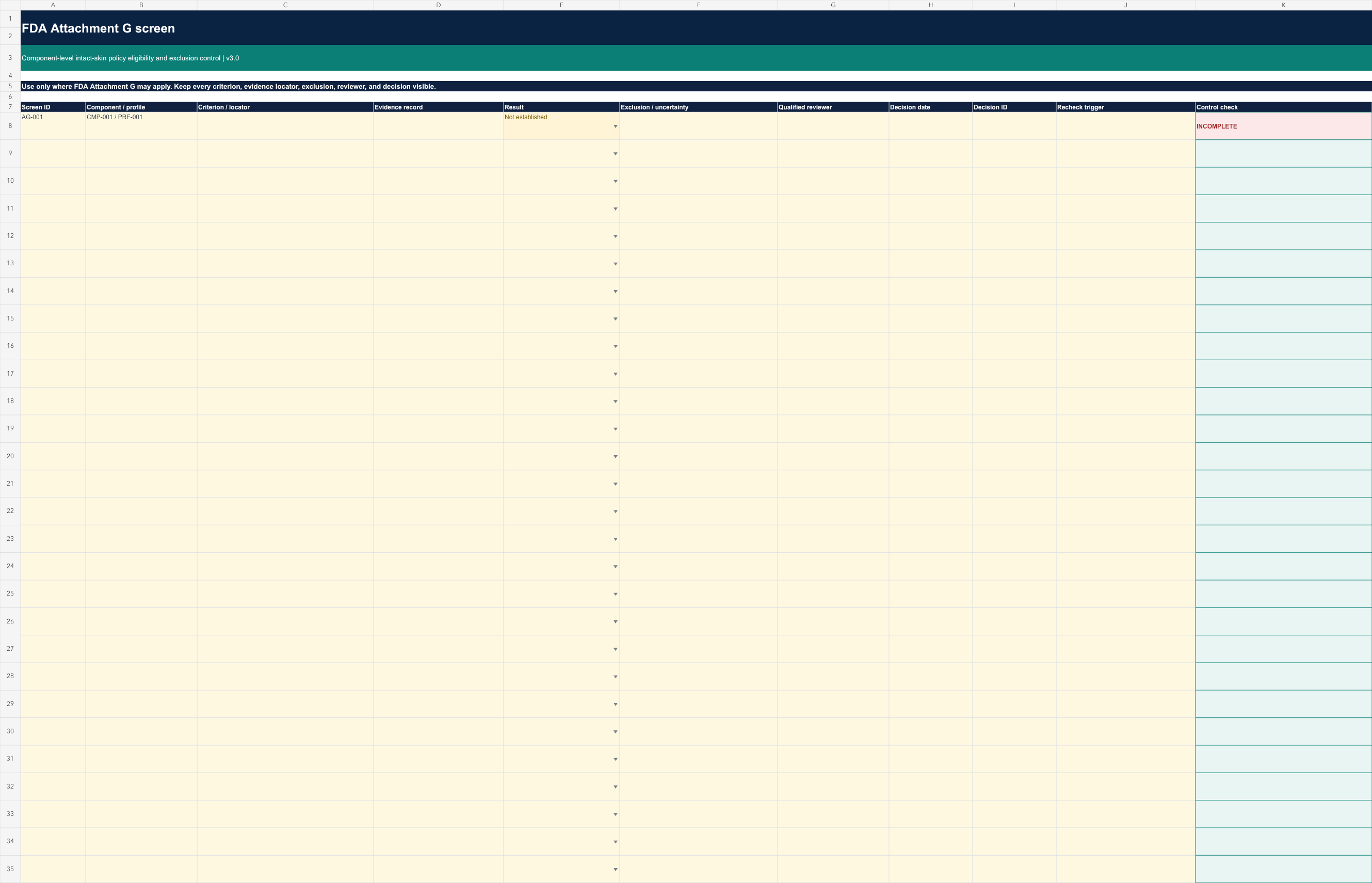
These are direct renders of the current v3.0 workbook prepared as public product views, not marketing mock-ups. Select any image to inspect it at full size.
How the resource is intended to be used
The complete Quick Start and implementation guide are included in the current v3.0 customer edition. This public walkthrough lets a buyer inspect the operating logic and stop conditions before requesting an exact offer.
Controlled device/use profile
Freeze the exact wearable system, variants, claims, intended sites, skin condition, user population, and labelled application regimen.
Stop if: A variant, wear interval, repeat-use pattern, body site, skin condition, or accessory is undefined.
Cumulative wear record
Calculate cumulative contact across repeated, sequential, overlapping, or adjacent applications and separate patient exposure from single-unit wear time.
Stop if: Replacement frequency, off-time, total treatment period, reuse, or adjacent placement is unknown.
Component/contact-zone map
Map every finished-device component and plausible transfer path to direct, indirect, transient, or non-contact zones.
Stop if: An adhesive edge, gel, ink, coating, residue, housing interface, or migration path is omitted or assumed non-contact without evidence.
Finished-state material baseline
Control material identity, formulation, supplier, process, cleaning, packaging, ageing, storage, and finished-state differences for each contacting component.
Stop if: A proprietary constituent, processing aid, residue, supplier change, or manufacturing difference is unresolved.
Attachment G decision record
Screen FDA Attachment G eligibility component by component, record every criterion and exclusion, and preserve the qualified decision and source locator.
Stop if: Eligibility is inferred from a generic material name, applied to the whole device, or used despite a novel material/process, incomplete composition, or non-intact-skin use.
Endpoint/evidence map
Map each biological endpoint to current evidence, test article, real-use relevance, limitations, and a named scientific decision.
Stop if: A checkbox, supplier certificate, predicate statement, or historical report substitutes for device-specific applicability analysis.
Real-use challenge assessment
Challenge the evidence against sweat, heat, occlusion, motion, pressure, conductive media, repeated removal and reapplication, cleaning, ageing, and foreseeable misuse.
Stop if: The tested or characterized article does not represent the worst relevant finished-state exposure.
Controlled evaluation candidate
Reconcile changes, complaints, clinical experience, gaps, actions, qualified reviews, and delivery-file identities before handoff.
Stop if: A material gap, conflict, red flag, open action, unreviewed conclusion, or file mismatch remains hidden.
Current public authorities behind the working controls
Sources were checked 2026-08-02; next planned portfolio recheck is 2026-11-02. Live status must still be verified at each material decision or submission event.
FDA · Use of International Standard ISO 10993-1 — final guidance
Final guidance issued September 8, 2023. Includes risk-based evaluation, final-finished-device considerations, and Attachment G for certain intact-skin-contacting devices.
FDA · Basics of Biocompatibility: Information Needed for Assessment by the FDA
Current FDA education page. Frames assessment around materials, processing, clinical use, anatomy, frequency, and duration; points to Attachment G for certain intact-skin devices.
FDA · Biocompatibility Evaluation Endpoints by Device Category
Current FDA framework page. Endpoint tables are considerations, not a stand-alone testing checklist; intact-skin surface contact includes cytotoxicity, sensitization, and irritation considerations across durations.
FDA · Biocompatibility Evaluation Endpoints by Contact Duration Periods
Current FDA duration-based framework. Duration categories and endpoint tables require device-specific interpretation and current guidance.
FDA · Glossary of Biocompatibility Terms
Current FDA glossary. It describes contact duration as the cumulative sum of single, multiple, or repeated contact and cautions against unrelated safety extrapolations.
FDA · Electrocardiograph Electrodes — Class II Special Controls Guidance
Device-specific guidance retained for contextual recommendations on skin-contacting gels, adhesives, electrodes, intended-use conditions, adhesive performance, and shelf life. Its older cited standards do not override current editions or the 2023 biocompatibility guidance.
What the resource deliberately does not promise
Clear boundaries protect the buyer and make the working records more useful to qualified reviewers.
Clear boundary 1
No automatic FDA Attachment G eligibility, endpoint applicability, testing, biological-safety, toxicological, clinical, substantial-equivalence, or conformity conclusion.
Clear boundary 2
No assumption that a generic material name, supplier certificate, 'medical grade' claim, legacy report, market history, or lack of complaints establishes current finished-device safety.
Clear boundary 3
No universal categorization based only on one electrode or patch wear interval; cumulative repeated contact and the actual use profile require qualified interpretation.
Clear boundary 4
No reproduction of ISO standards or replacement for lawfully obtained standards, current regulator guidance, product-specific requirements, and the exact controlled device record.
Questions to settle before requesting an offer
Is the current v3.0 edition available?
Yes. The current v3.0 customer edition is released and available by request. Online checkout, payment, customer download, and automatic delivery are not currently enabled. Use Request Exact Offer to receive the controlled offer before deciding whether to pay.
What is included in the current v3.0 edition?
The verified archive contains 11 ZIP entries: 9 buyer payload files plus MANIFEST.csv and SHA-256 checksums. It includes a 3-page Quick Start, 20-page implementation guide, 12-page editable templates, and 18-sheet workbook. Final document, workbook, visual, and archive-integrity QA are complete.
Does the resource provide a completed regulatory or biological conclusion?
No. It provides a traceable working system. Device-specific conclusions, testing decisions, toxicological judgments, and submission decisions require qualified review.
Can I inspect the product before requesting an offer?
Yes. This page shows the complete workflow and real v3.0 product views, while the downloadable 5-page public preview explains the scope, operating logic, included files, and important limits.
Wearable Electrode and Skin-Contact Biocompatibility
Assess adhesives, hydrogels, conductive materials, repeated application, cumulative duration and realistic skin condition without assuming an intact-skin shortcut.
Review the workflow now. Request the exact current offer.
No order, payment, customer download, or delivery is created through this page. The controlled offer identifies the exact version, licence, price, update option, policies, and delivery method for your review before any payment decision.