Reusable Surgical Instrument Biocompatibility & Reprocessing Evidence Pack
Help medical-device teams build a traceable evidence-readiness file for manufacturer-labeled reusable surgical instruments whose clinical use, repeated processing, residues, surface condition, and service life can affect biological evaluation.
Package at a glance
11 ZIP entries
The current customer archive passed exact-inventory, checksum, and deterministic-rebuild QA.
18 workbook sheets
A fail-closed working system with sample content kept separate.
4-page Quick Start
A concise route through the files, controls, and escalation points.
29 official sources
Source status, limitations, retrieval dates, and recheck triggers.
A traceable working record—not a shortcut to a conclusion
Final-use state, reprocessing validation, residue, durability, service-life, and biological-evidence controls
Controlled Reusable-Instrument Scope
A bounded reusable-instrument scope that distinguishes manufacturer-labeled reuse from third-party reprocessing of a single-use device.
Final-Use-State Baseline
A final-use-state baseline linking every patient-contacting component to material, surface, cleaning, disinfection or sterilization, drying, inspection, maintenance, packaging, storage, and reuse conditions.
Traceable Reprocessing and IFU Evidence
A stepwise reprocessing map with validated instruction, accessory, water, equipment, parameter, hold-time, and handoff references.
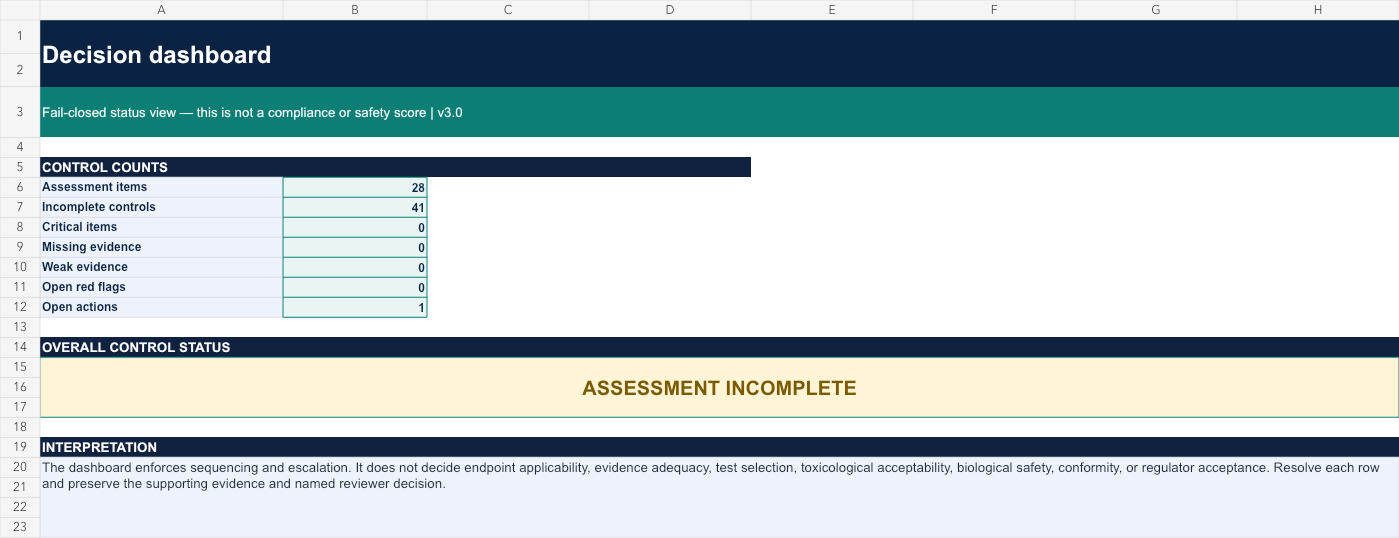
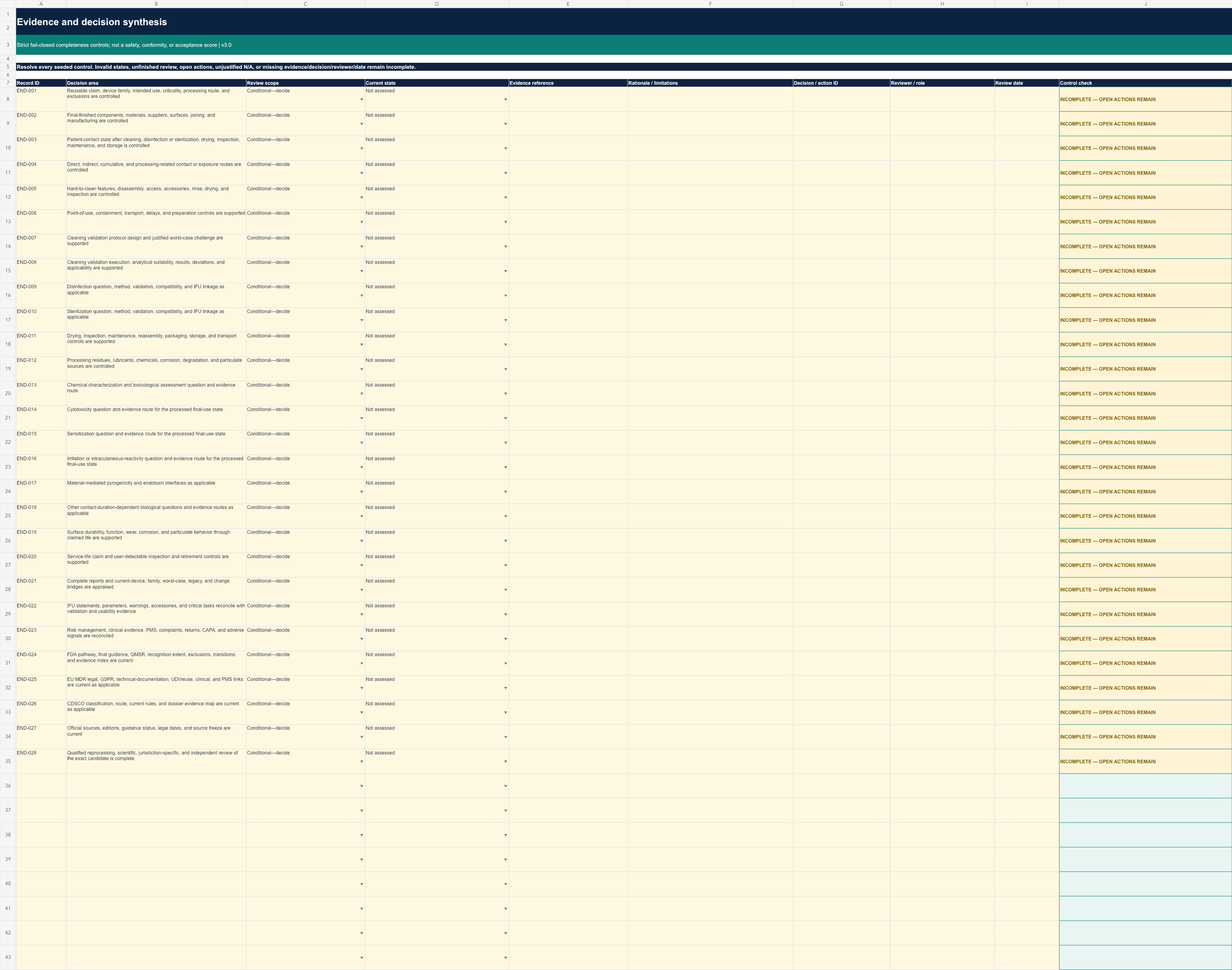
Fail-Closed Decision Synthesis
Cleaning, disinfection or sterilization, residue, durability, and service-life evidence appraisals that preserve worst-case conditions, deviations, limitations, and current-device applicability.
What the current customer edition contains
The verified v3.0 archive contains 9 buyer payload files plus MANIFEST.csv and SHA-256 checksums. Final document, workbook, visual, and archive-integrity QA are complete.
Quick Start PDF
Choose the bounded reusable-instrument pathway, follow the safe sequence, and recognize stop conditions.
Complete when: The team knows which records to complete, who owns each decision, and when external use must stop.
Implementation Guide PDF
Understand final-use state, reprocessing, validation, residues, durability, life, labeling, lifecycle, and jurisdiction controls.
Complete when: The team can explain each proposed conclusion, evidence route, limitation, and approval boundary without generic reuse claims.
Editable Working Templates DOCX
Draft scope, final-state, validation, residue, life, mapping, decision, and sign-off records.
Complete when: Every response area contains device-specific content and each open issue has an owner, action, and due date.
Operational Workbook XLSX
Control device facts, processing steps, evidence, IFU trace, sources, red flags, actions, and decisions.
Complete when: No invalid or incomplete control remains, all actions are closed, and terminal rows have evidence, rationale, decision ID, reviewer, and date.
Source Status and Release Notes PDF
Verify publication status, FDA recognition extent and exclusions, transitions, guidance status, and legal-source dates.
Complete when: The source register matches the exact authorities and controlled editions used for the candidate decision.
Customer README, responsible-use terms, and source register
Orient recipients, preserve identity, and control authorized use and update expectations.
Complete when: Title, product and workbook IDs, version, files, source date, support route, and use boundaries agree.
Inspect the actual working system
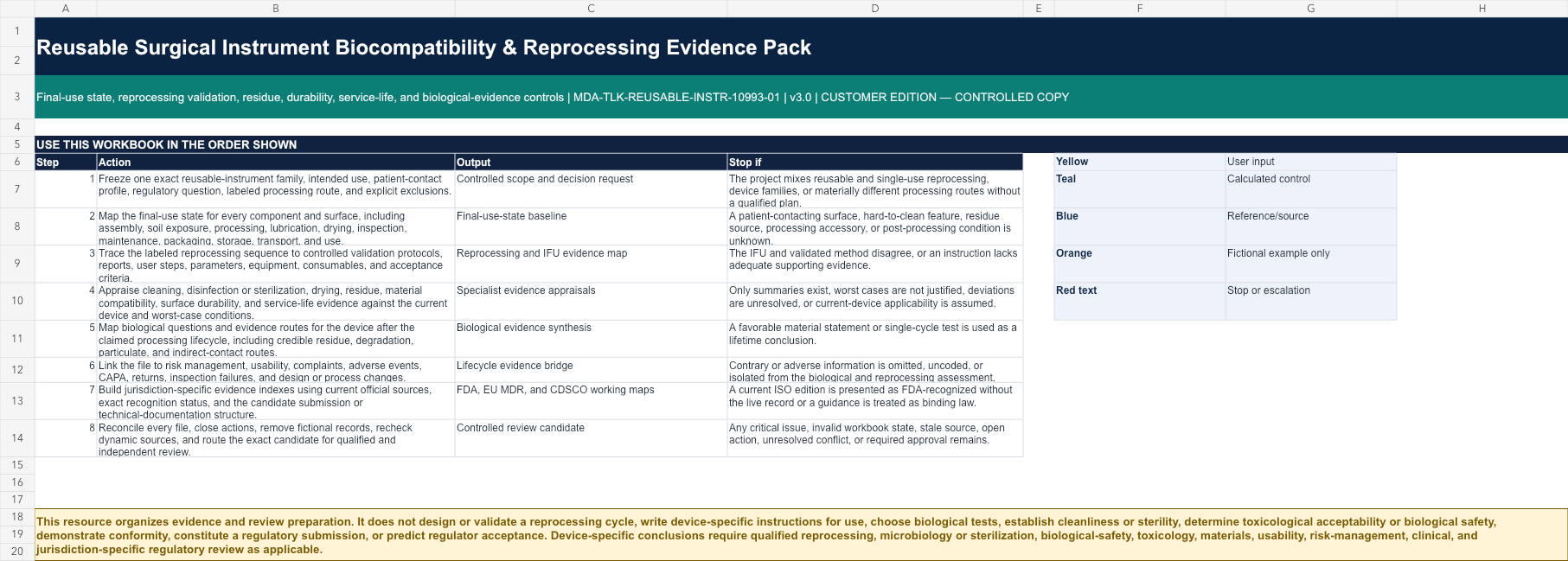
These are direct renders of the current v3.0 workbook prepared as public product views, not marketing mock-ups. Select any image to inspect it at full size.
How the resource is intended to be used
The complete Quick Start and implementation guide are included in the current v3.0 customer edition. This public walkthrough lets a buyer inspect the operating logic and stop conditions before requesting an exact offer.
Controlled scope and decision request
Freeze one exact reusable-instrument family, intended use, patient-contact profile, regulatory question, labeled processing route, and explicit exclusions.
Stop if: The project mixes reusable and single-use reprocessing, device families, or materially different processing routes without a qualified plan.
Final-use-state baseline
Map the final-use state for every component and surface, including assembly, soil exposure, processing, lubrication, drying, inspection, maintenance, packaging, storage, transport, and use.
Stop if: A patient-contacting surface, hard-to-clean feature, residue source, processing accessory, or post-processing condition is unknown.
Reprocessing and IFU evidence map
Trace the labeled reprocessing sequence to controlled validation protocols, reports, user steps, parameters, equipment, consumables, and acceptance criteria.
Stop if: The IFU and validated method disagree, or an instruction lacks adequate supporting evidence.
Specialist evidence appraisals
Appraise cleaning, disinfection or sterilization, drying, residue, material compatibility, surface durability, and service-life evidence against the current device and worst-case conditions.
Stop if: Only summaries exist, worst cases are not justified, deviations are unresolved, or current-device applicability is assumed.
Biological evidence synthesis
Map biological questions and evidence routes for the device after the claimed processing lifecycle, including credible residue, degradation, particulate, and indirect-contact routes.
Stop if: A favorable material statement or single-cycle test is used as a lifetime conclusion.
Lifecycle evidence bridge
Link the file to risk management, usability, complaints, adverse events, CAPA, returns, inspection failures, and design or process changes.
Stop if: Contrary or adverse information is omitted, uncoded, or isolated from the biological and reprocessing assessment.
FDA, EU MDR, and CDSCO working maps
Build jurisdiction-specific evidence indexes using current official sources, exact recognition status, and the candidate submission or technical-documentation structure.
Stop if: A current ISO edition is presented as FDA-recognized without the live record or a guidance is treated as binding law.
Controlled review candidate
Reconcile every file, close actions, remove fictional records, recheck dynamic sources, and route the exact candidate for qualified and independent review.
Stop if: Any critical issue, invalid workbook state, stale source, open action, unresolved conflict, or required approval remains.
Current public authorities behind the working controls
Sources were checked 2026-08-02; next planned portfolio recheck is 2026-11-02. Live status must still be verified at each material decision or submission event.
ISO · ISO 10993-1:2025 catalog record
Published international standard, edition 6. Use a lawfully obtained copy; publication does not establish FDA recognition.
FDA · FDA recognition record 2-313 - ISO 10993-1:2025
Partial recognition entered 2026-05-25 with exclusions and implementation caution. Recheck the live record.
FDA · FDA transition record 2-258 - ISO 10993-1:2018
Prior edition recognition record with FDA transition information through 2029-07-01 as checked.
FDA · Use of International Standard ISO 10993-1 - final guidance, September 2023
Final FDA guidance. Apply with current recognition records and device-specific controls.
FDA · Biocompatibility Evaluation Endpoints by Device Category
General FDA endpoint framework; not an automatic testing checklist or device conclusion.
FDA · Reprocessing Medical Devices in Health Care Settings - final guidance, March 2015
Final FDA guidance for formulation and scientific validation of reprocessing instructions and related premarket information. Appendix E was updated in 2017.
What the resource deliberately does not promise
Clear boundaries protect the buyer and make the working records more useful to qualified reviewers.
Clear boundary 1
No automated reprocessing-cycle design, validation acceptance, test selection, endpoint applicability, worst-case selection, reuse limit, or regulatory pathway.
Clear boundary 2
No cleanliness, sterility, toxicological acceptability, biological safety, conformity, submission-readiness, or regulator-acceptance determination.
Clear boundary 3
No coverage of reprocessed single-use devices, flexible or semi-rigid endoscopes, powered capital equipment, implants, or facility sterile-processing operations without separate review.
Clear boundary 4
No reproduction of ISO or AAMI standards or replacement for lawfully obtained standards, current legal text, device-specific guidance, and qualified review.
Questions to settle before requesting an offer
Is the current v3.0 edition available?
Yes. The current v3.0 customer edition is released and available by request. Online checkout, payment, customer download, and automatic delivery are not currently enabled. Use Request Exact Offer to receive the controlled offer before deciding whether to pay.
What is included in the current v3.0 edition?
The verified archive contains 11 ZIP entries: 9 buyer payload files plus MANIFEST.csv and SHA-256 checksums. It includes a 4-page Quick Start, 21-page implementation guide, 16-page editable templates, and 18-sheet workbook. Final document, workbook, visual, and archive-integrity QA are complete.
Does the resource provide a completed regulatory or biological conclusion?
No. It provides a traceable working system. Device-specific conclusions, testing decisions, toxicological judgments, and submission decisions require qualified review.
Can I inspect the product before requesting an offer?
Yes. This page shows the complete workflow and real v3.0 product views, while the downloadable 5-page public preview explains the scope, operating logic, included files, and important limits.
Reusable-Instrument Biocompatibility After Reprocessing
Connect cleaning, disinfection or sterilization cycles, residues, surface change and end-of-life device condition to the biological-evaluation record.
Review the workflow now. Request the exact current offer.
No order, payment, customer download, or delivery is created through this page. The controlled offer identifies the exact version, licence, price, update option, policies, and delivery method for your review before any payment decision.