Orthopedic Fixation & Root-Form Dental Implant Biological Evaluation Evidence-Readiness Pack
Help medical-device teams build a traceable biological-evaluation evidence file for non-spinal orthopedic fixation devices and root-form dental implants or abutments, with explicit source status, limitations, actions, and qualified-review gates.
Package at a glance
11 ZIP entries
The current customer archive passed exact-inventory, checksum, and deterministic-rebuild QA.
17 workbook sheets
A fail-closed working system with sample content kept separate.
3-page Quick Start
A concise route through the files, controls, and escalation points.
35 official sources
Source status, limitations, retrieval dates, and recheck triggers.
A traceable working record—not a shortcut to a conclusion
Surface state, local tissue response, degradation, wear, chemistry, and pathway evidence controls
Controlled Implant Pathway Scope
A controlled device and pathway scope that keeps non-spinal orthopedic fixation and root-form dental implant or abutment records distinct.
Final-Finished Configuration Baseline
A final-finished configuration record linking components, material grades, suppliers, surfaces, coatings, processing, cleaning, passivation, sterilization, packaging, ageing, and use.
Traceable Evidence and Applicability Register
An evidence register with exact report identity, test article, method, result, deviation, locator, current-device bridge, uncertainty, and qualified-review state.
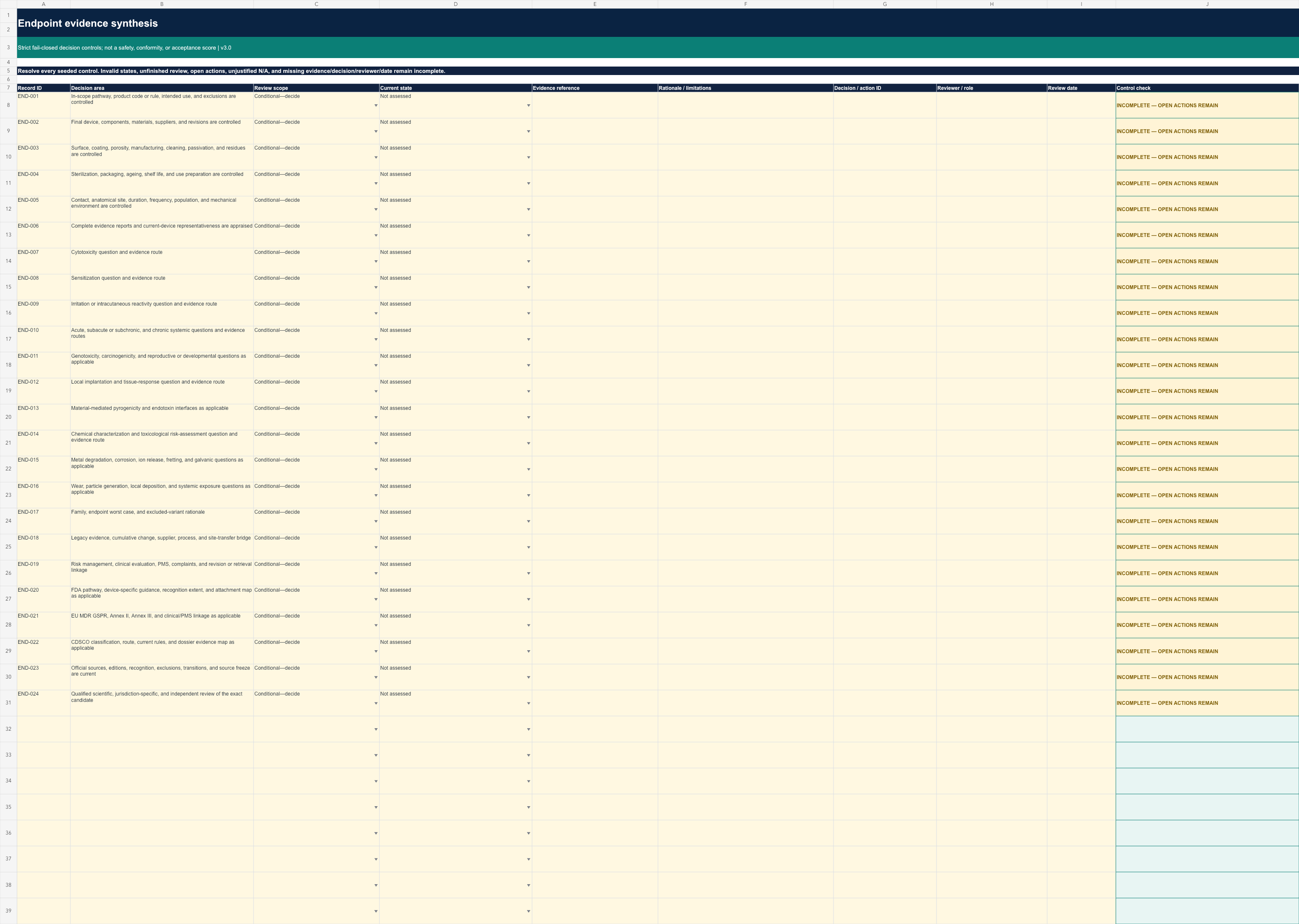
Fail-Closed Endpoint Synthesis
A fail-closed endpoint synthesis that cannot show a completed control when required scope, evidence, rationale, decision, reviewer, or date is absent or invalid.
What the current customer edition contains
The verified v3.0 archive contains 9 buyer payload files plus MANIFEST.csv and SHA-256 checksums. Final document, workbook, visual, and archive-integrity QA are complete.
Quick Start PDF
Choose the bounded pathway, follow the safe sequence, and recognize every stop condition.
Complete when: The team knows which records to complete, who owns each decision, and when external use must stop.
Implementation Guide PDF
Understand configuration, local tissue, degradation, chemistry, lifecycle, and jurisdiction-specific evidence controls.
Complete when: The team can explain each proposed conclusion, evidence route, limitation, and approval boundary without generic implant claims.
Editable Working Templates DOCX
Draft scope, configuration, appraisal, bridge, mapping, decision, and sign-off records.
Complete when: Every response area contains device-specific content and each open issue has an owner, action, and due date.
Operational Workbook XLSX
Control device facts, evidence, sources, specialist records, endpoint states, red flags, actions, and decisions.
Complete when: No invalid or incomplete control remains, all actions are closed, and terminal rows have evidence, rationale, decision ID, reviewer, and date.
Source Status and Release Notes PDF
Verify publication status, FDA recognition extent, exclusions, transitions, draft/final guidance status, and legal-source dates.
Complete when: The source register matches the exact authorities and controlled editions used for the candidate decision.
Customer README, responsible-use terms, and source register
Orient recipients, preserve identity, and control authorized use and update expectations.
Complete when: Title, product and workbook IDs, version, files, source date, support route, and use boundaries agree.
Inspect the actual working system
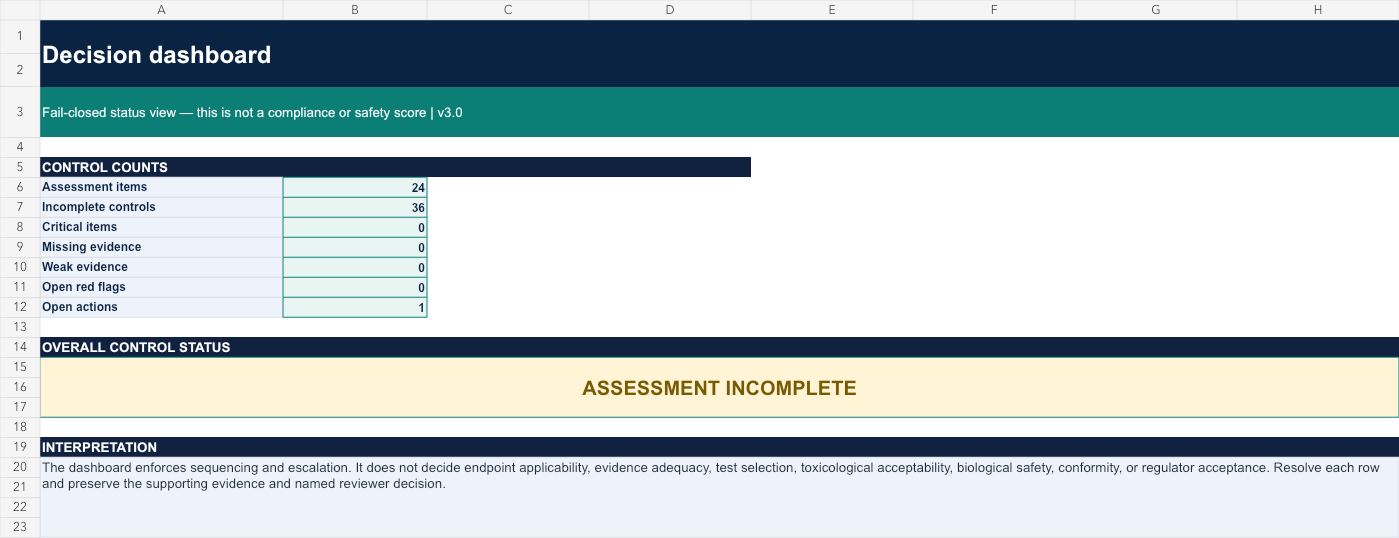
These are direct renders of the current v3.0 workbook prepared as public product views, not marketing mock-ups. Select any image to inspect it at full size.
How the resource is intended to be used
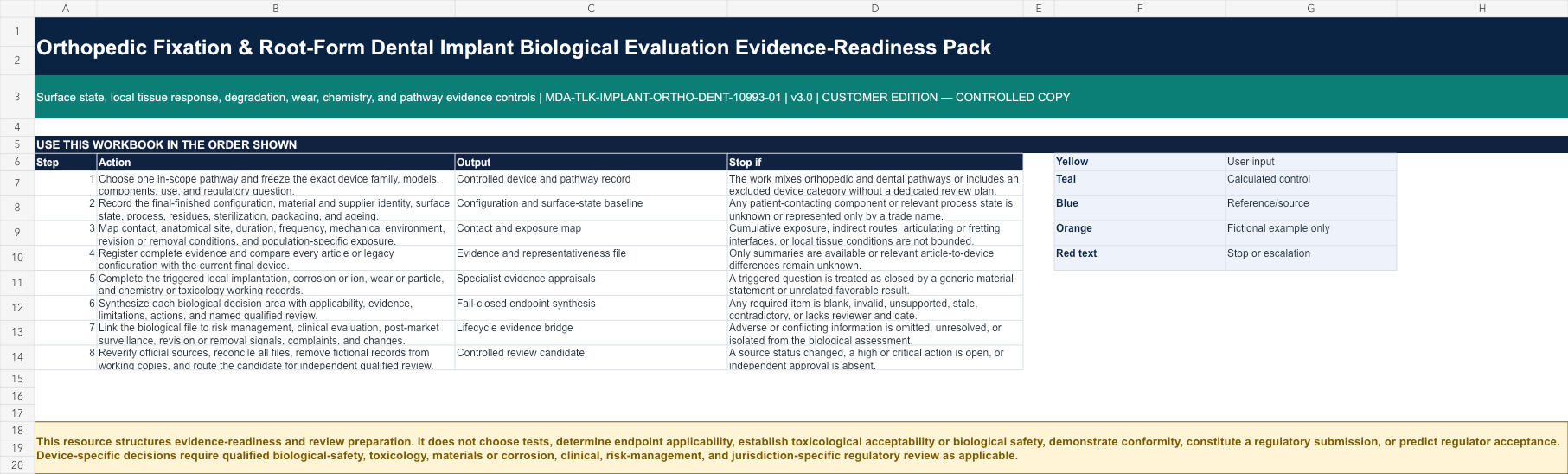
The complete Quick Start and implementation guide are included in the current v3.0 customer edition. This public walkthrough lets a buyer inspect the operating logic and stop conditions before requesting an exact offer.
Controlled device and pathway record
Choose one in-scope pathway and freeze the exact device family, models, components, use, and regulatory question.
Stop if: The work mixes orthopedic and dental pathways or includes an excluded device category without a dedicated review plan.
Configuration and surface-state baseline
Record the final-finished configuration, material and supplier identity, surface state, process, residues, sterilization, packaging, and ageing.
Stop if: Any patient-contacting component or relevant process state is unknown or represented only by a trade name.
Contact and exposure map
Map contact, anatomical site, duration, frequency, mechanical environment, revision or removal conditions, and population-specific exposure.
Stop if: Cumulative exposure, indirect routes, articulating or fretting interfaces, or local tissue conditions are not bounded.
Evidence and representativeness file
Register complete evidence and compare every article or legacy configuration with the current final device.
Stop if: Only summaries are available or relevant article-to-device differences remain unknown.
Specialist evidence appraisals
Complete the triggered local implantation, corrosion or ion, wear or particle, and chemistry or toxicology working records.
Stop if: A triggered question is treated as closed by a generic material statement or unrelated favorable result.
Fail-closed endpoint synthesis
Synthesize each biological decision area with applicability, evidence, limitations, actions, and named qualified review.
Stop if: Any required item is blank, invalid, unsupported, stale, contradictory, or lacks reviewer and date.
Lifecycle evidence bridge
Link the biological file to risk management, clinical evaluation, post-market surveillance, revision or removal signals, complaints, and changes.
Stop if: Adverse or conflicting information is omitted, unresolved, or isolated from the biological assessment.
Controlled review candidate
Reverify official sources, reconcile all files, remove fictional records from working copies, and route the candidate for independent qualified review.
Stop if: A source status changed, a high or critical action is open, or independent approval is absent.
Current public authorities behind the working controls
Sources were checked 2026-08-02; next planned portfolio recheck is 2026-11-02. Live status must still be verified at each material decision or submission event.
ISO · ISO 10993-1:2025 catalog record
Published international standard, edition 6. Use a lawfully obtained copy for requirements; the catalog record does not establish FDA recognition.
FDA · FDA recognition record 2-313 - ISO 10993-1:2025
Partial FDA recognition entered 2026-05-25. The record contains exclusions and an implementation caution; consult the live record before relying on it.
FDA · FDA transition record 2-258 - ISO 10993-1:2018
Previously recognized edition; FDA lists a transition through 2029-07-01. Confirm the live record for the candidate event.
FDA · Use of International Standard ISO 10993-1 - final guidance, September 2023
Final FDA guidance. Apply with current recognition records and device-specific guidance or special controls.
FDA · Biocompatibility Evaluation Endpoints by Device Category
General FDA endpoint framework; it is not an automatic testing checklist or device conclusion.
FDA · What Should I Put in a Test Report?
Current FDA public resource describing report information expectations; verify any applicable conformity or ASCA pathway separately.
What the resource deliberately does not promise
Clear boundaries protect the buyer and make the working records more useful to qualified reviewers.
Clear boundary 1
No automated selection of tests, endpoint applicability, worst case, evidence equivalence, classification, or regulatory pathway.
Clear boundary 2
No biological-safety, toxicological-acceptability, conformity, submission-readiness, or regulator-acceptance determination.
Clear boundary 3
No coverage of articulating joint replacements, spinal systems, degradable or resorbable implants, combination products, tissue-derived devices, or patient-matched additive-manufactured devices.
Clear boundary 4
No reproduction of ISO standards or replacement for lawfully obtained standards, current legal text, device-specific guidance, special controls, and qualified review.
Questions to settle before requesting an offer
Is the current v3.0 edition available?
Yes. The current v3.0 customer edition is released and available by request. Online checkout, payment, customer download, and automatic delivery are not currently enabled. Use Request Exact Offer to receive the controlled offer before deciding whether to pay.
What is included in the current v3.0 edition?
The verified archive contains 11 ZIP entries: 9 buyer payload files plus MANIFEST.csv and SHA-256 checksums. It includes a 3-page Quick Start, 20-page implementation guide, 17-page editable templates, and 17-sheet workbook. Final document, workbook, visual, and archive-integrity QA are complete.
Does the resource provide a completed regulatory or biological conclusion?
No. It provides a traceable working system. Device-specific conclusions, testing decisions, toxicological judgments, and submission decisions require qualified review.
Can I inspect the product before requesting an offer?
Yes. This page shows the complete workflow and real v3.0 product views, while the downloadable 5-page public preview explains the scope, operating logic, included files, and important limits.
Biocompatibility for Long-Term Implantable Devices
Review the additional material, surface, degradation, particle, local-tissue and long-duration questions that implantable devices can create.
Review the workflow now. Request the exact current offer.
No order, payment, customer download, or delivery is created through this page. The controlled offer identifies the exact version, licence, price, update option, policies, and delivery method for your review before any payment decision.