ISO 10993-1:2025 BER Evidence & Literature Evaluation Toolkit
Help medical-device teams turn controlled test reports, chemistry, toxicology, literature, legacy evidence, clinical and post-market information, and risk records into a traceable Biological Evaluation Report evidence argument for qualified review.
Package at a glance
11 ZIP entries
The current customer archive passed exact-inventory, checksum, and deterministic-rebuild QA.
18 workbook sheets
A fail-closed working system with sample content kept separate.
3-page Quick Start
A concise route through the files, controls, and escalation points.
25 official sources
Source status, limitations, retrieval dates, and recheck triggers.
A traceable working record—not a shortcut to a conclusion
Device-specific evidence applicability, reproducible literature evaluation, endpoint synthesis, chemistry/TRA linkage, and qualified BER review
Controlled BER Evidence Map
A controlled BER question tied to the exact final finished device, intended use, contact route, cumulative duration, population, materials, processing, sterilization, packaging, and life-cycle state.
Reproducible Literature Trail
A provenance-controlled evidence inventory that distinguishes possession of a document from its applicability to the current device and question.
Transparent Critical Appraisal
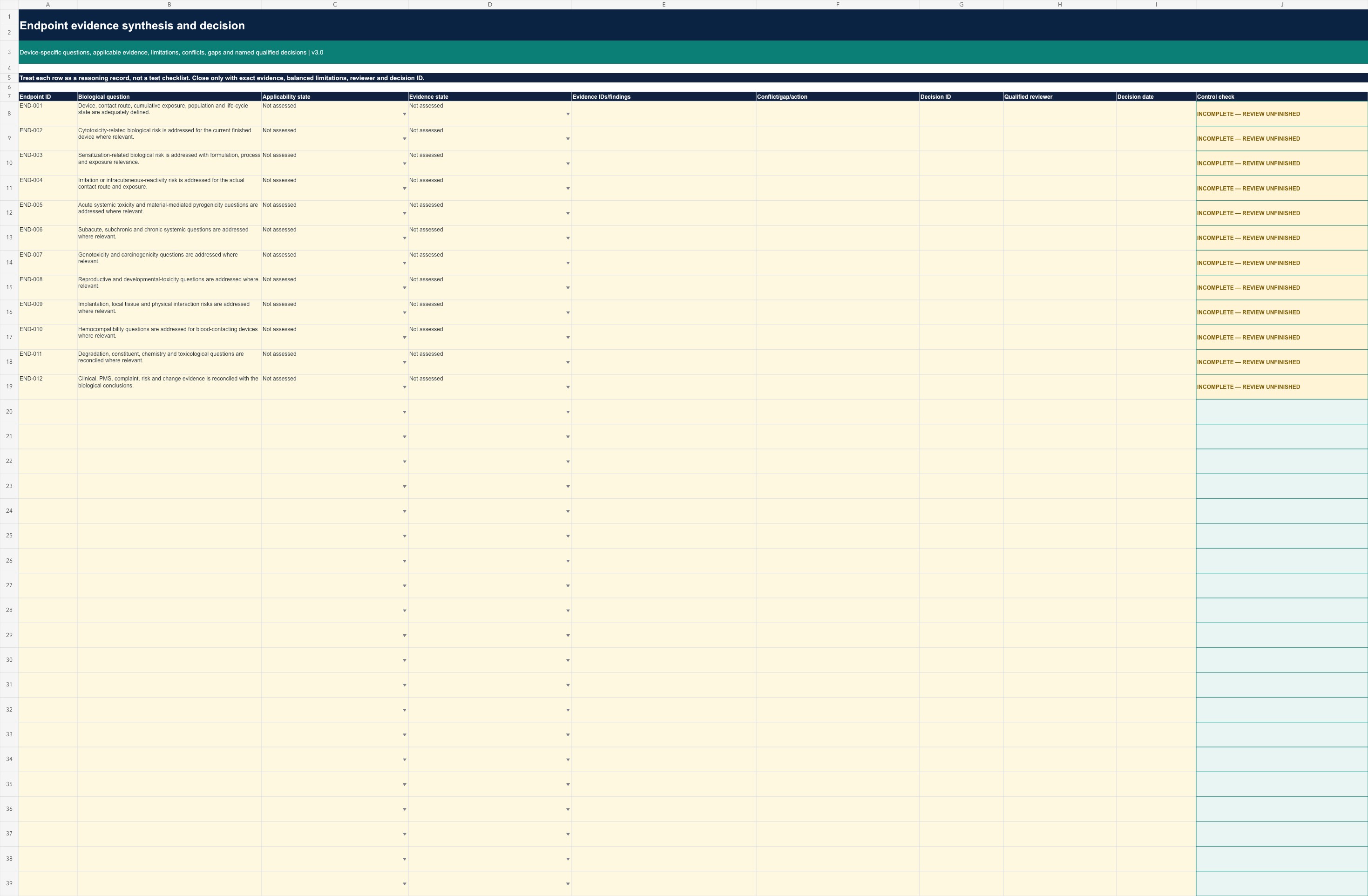
An endpoint-by-endpoint synthesis linking biological questions to direct and indirect evidence, limitations, conflicts, residual uncertainty, and named qualified decisions.
Qualified Review Handoff
A reproducible literature mini-protocol, search log, deduplication record, screening trail, critical appraisal, and evidence-extraction record without an invented quality score.
What the current customer edition contains
The verified v3.0 archive contains 9 buyer payload files plus MANIFEST.csv and SHA-256 checksums. Final document, workbook, visual, and archive-integrity QA are complete.
Quick Start PDF
Run the first-pass evidence and literature workflow in the correct order.
Complete when: The team knows the controlled question, minimum evidence set, literature route, stop conditions, and next qualified-review action.
Implementation Guide PDF
Apply the full evidence-applicability, literature-evaluation, endpoint-synthesis, chemistry/TRA, legacy, PMS/risk, and close-out method.
Complete when: A reviewer can reconstruct what was searched, what was excluded, what evidence was used, why it applies, what conflicts remain, and who owns the conclusion.
Editable Working Templates DOCX
Draft thirteen controlled BER evidence and literature records.
Complete when: Every instruction field is completed with device-specific information and each terminal record is linked to a named qualified reviewer.
Operational Workbook XLSX
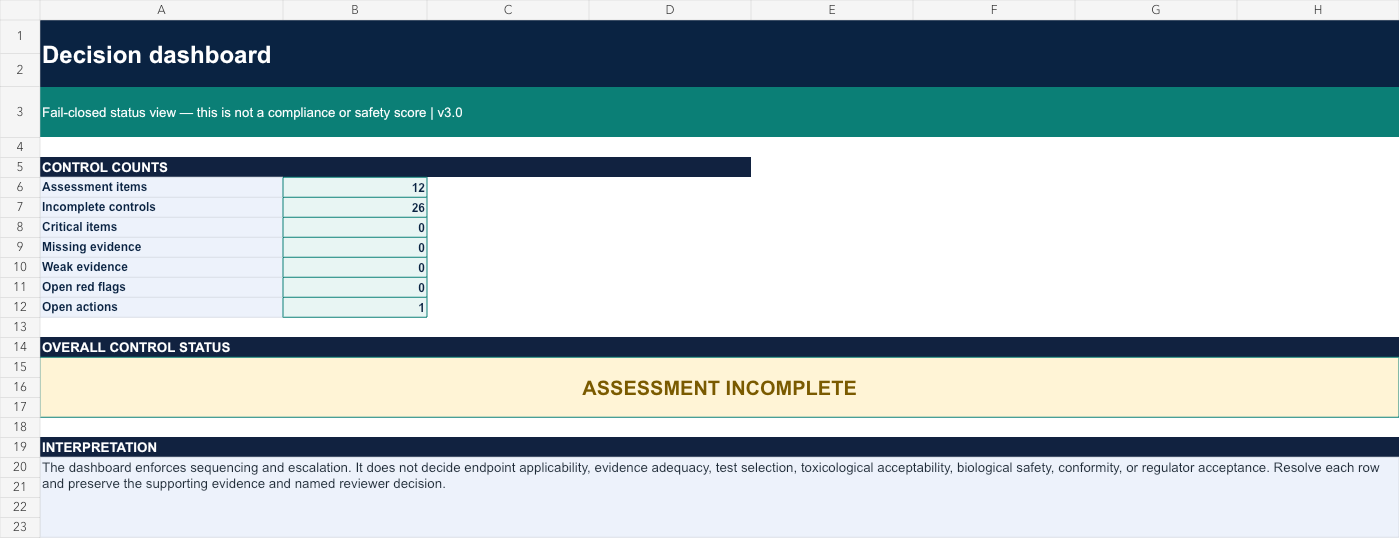
Control scope, evidence, applicability, endpoints, literature work, cross-evidence bridges, gaps, red flags, changes, actions, sources, and decisions.
Complete when: Every seeded control is assessed, screening and appraisal records are complete, and the dashboard remains fail-closed until qualified decisions exist.
Source Status and Release Notes PDF
Review the official ISO, FDA, EU, IMDRF, eCFR, and MDCG source status behind the candidate.
Complete when: Edition, recognition extent, transition, guidance status, checked date, and recheck trigger agree with the intended use.
README, responsible-use terms, source register, manifest, and checksums
Orient the buyer and preserve controlled-package identity.
Complete when: Product ID, version, inventory, hashes, professional-use boundary, and support route agree across delivery.
Inspect the actual working system
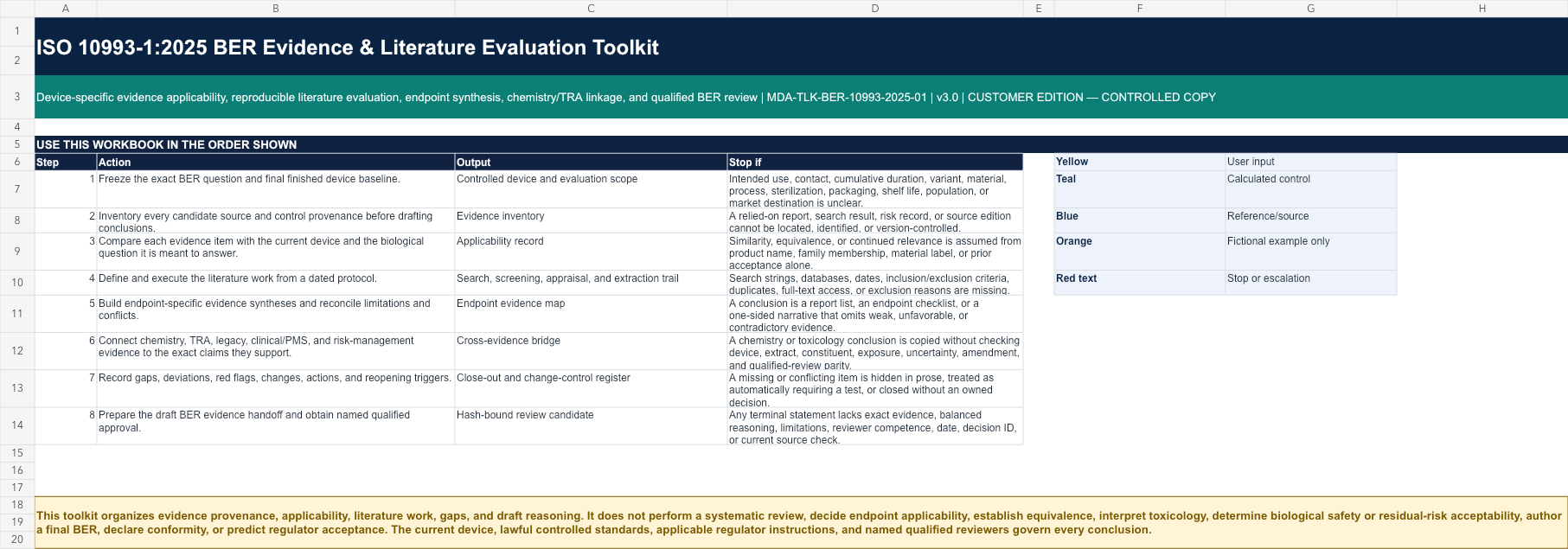
These are direct renders of the current v3.0 workbook prepared as public product views, not marketing mock-ups. Select any image to inspect it at full size.
How the resource is intended to be used
The complete Quick Start and implementation guide are included in the current v3.0 customer edition. This public walkthrough lets a buyer inspect the operating logic and stop conditions before requesting an exact offer.
Controlled device and evaluation scope
Freeze the exact BER question and final finished device baseline.
Stop if: Intended use, contact, cumulative duration, variant, material, process, sterilization, packaging, shelf life, population, or market destination is unclear.
Evidence inventory
Inventory every candidate source and control provenance before drafting conclusions.
Stop if: A relied-on report, search result, risk record, or source edition cannot be located, identified, or version-controlled.
Applicability record
Compare each evidence item with the current device and the biological question it is meant to answer.
Stop if: Similarity, equivalence, or continued relevance is assumed from product name, family membership, material label, or prior acceptance alone.
Search, screening, appraisal, and extraction trail
Define and execute the literature work from a dated protocol.
Stop if: Search strings, databases, dates, inclusion/exclusion criteria, duplicates, full-text access, or exclusion reasons are missing.
Endpoint evidence map
Build endpoint-specific evidence syntheses and reconcile limitations and conflicts.
Stop if: A conclusion is a report list, an endpoint checklist, or a one-sided narrative that omits weak, unfavorable, or contradictory evidence.
Cross-evidence bridge
Connect chemistry, TRA, legacy, clinical/PMS, and risk-management evidence to the exact claims they support.
Stop if: A chemistry or toxicology conclusion is copied without checking device, extract, constituent, exposure, uncertainty, amendment, and qualified-review parity.
Close-out and change-control register
Record gaps, deviations, red flags, changes, actions, and reopening triggers.
Stop if: A missing or conflicting item is hidden in prose, treated as automatically requiring a test, or closed without an owned decision.
Hash-bound review candidate
Prepare the draft BER evidence handoff and obtain named qualified approval.
Stop if: Any terminal statement lacks exact evidence, balanced reasoning, limitations, reviewer competence, date, decision ID, or current source check.
Current public authorities behind the working controls
Sources were checked 2026-08-02; next planned portfolio recheck is 2026-11-02. Live status must still be verified at each material decision or submission event.
ISO · ISO 10993-1:2025 catalog record
Published sixth edition dated 2025-11. Obtain and control a lawful copy; this toolkit does not reproduce protected standards text.
FDA · Recognition record 2-313 - ISO 10993-1:2025
Partial FDA recognition. The listed exclusions, implementation cautions, and ISO 14971 conflict note must be read before FDA use.
FDA · Recognition record 2-258 - ISO 10993-1:2018
Superseded recognition remains in a transition accepted for declarations of conformity through 2029-07-01, subject to the record and submission context.
FDA · Use of International Standard ISO 10993-1 - final guidance
Final guidance issued 2023-09-08. Use with current recognition records, device-specific guidances, and the current submission question.
FDA · Basics of Biocompatibility: Information Needed for Assessment
Current FDA educational resource verified active on the checked date.
FDA · Biocompatibility Evaluation Endpoints by Device Category
Current FDA framework; the page expressly states it is not a testing checklist.
What the resource deliberately does not promise
Clear boundaries protect the buyer and make the working records more useful to qualified reviewers.
Clear boundary 1
No automated endpoint applicability, testing recommendation, evidence inclusion, evidence-quality score, equivalence decision or sufficiency conclusion.
Clear boundary 2
No claim that a targeted search is systematic unless the approved method and reporting support that description.
Clear boundary 3
No toxicological calculation, tolerable exposure, margin, constituent acceptability or biological-safety conclusion.
Clear boundary 4
No automatic use of legacy, predicate, equivalent, same-material, family, PMS or complaint evidence without device- and question-specific applicability review.
Questions to settle before requesting an offer
Is the current v3.0 edition available?
Yes. The current v3.0 customer edition is released and available by request. Online checkout, payment, customer download, and automatic delivery are not currently enabled. Use Request Exact Offer to receive the controlled offer before deciding whether to pay.
What is included in the current v3.0 edition?
The verified archive contains 11 ZIP entries: 9 buyer payload files plus MANIFEST.csv and SHA-256 checksums. It includes a 3-page Quick Start, 22-page implementation guide, 15-page editable templates, and 18-sheet workbook. Final document, workbook, visual, and archive-integrity QA are complete.
Does the resource provide a completed regulatory or biological conclusion?
No. It provides a traceable working system. Device-specific conclusions, testing decisions, toxicological judgments, and submission decisions require qualified review.
Can I inspect the product before requesting an offer?
Yes. This page shows the complete workflow and real v3.0 product views, while the downloadable 7-page public preview explains the scope, operating logic, included files, and important limits.
How to Structure a Biological Evaluation Report
Read how a BER should connect device identity, evidence appraisal, endpoint conclusions, uncertainty and lifecycle obligations.
Review the workflow now. Request the exact current offer.
No order, payment, customer download, or delivery is created through this page. The controlled offer identifies the exact version, licence, price, update option, policies, and delivery method for your review before any payment decision.